

So, you've just landed at São Paulo/Guarulhos Airport (GRU) and need to get behind the wheel. The good news is you won't have to wander far. The major rental car desks are located right inside Terminals 2 and 3, so you can sort out your vehicle minutes after grabbing your bags. You'll see all the familiar names like Localiza, Avis, and Alamo ready to compete for your business right on-site.
Your Quick Guide to Car Rentals at GRU Airport
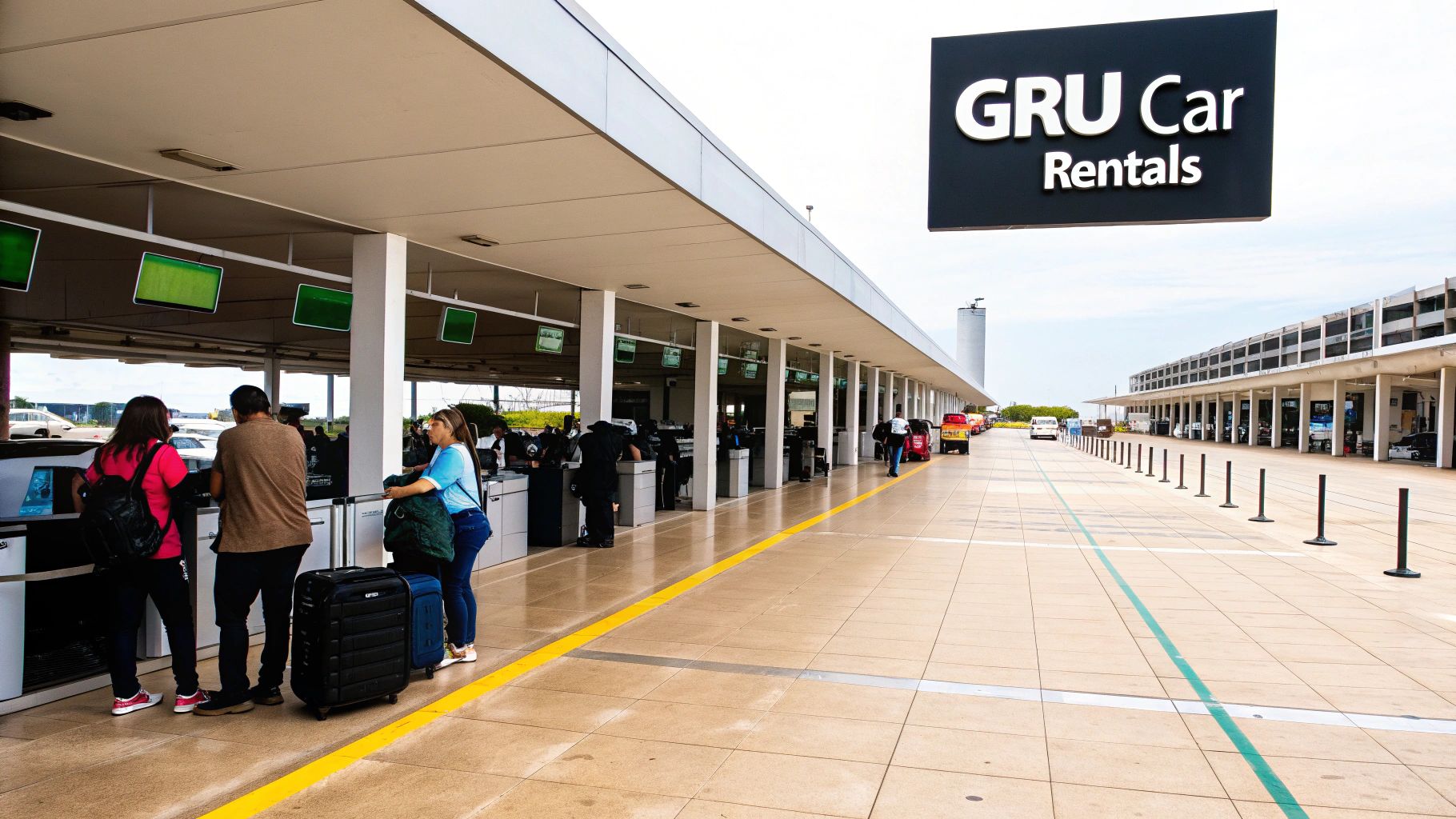
Welcome to São Paulo! After a long flight, the last thing you want is a complicated process to get on the road. This guide is designed to give you a quick, practical rundown of what to expect when you're arranging a rental car at São Paulo Guarulhos Airport.
Finding the Rental Desks
The main rental car companies have clustered their counters in the arrivals hall of both international terminals, which is a huge convenience.
- Terminal 2: Once you clear baggage claim, head to the ground floor. You'll spot the rental counters right there in the main arrivals area.
- Terminal 3: It's a similar setup here. The desks are positioned in the arrivals hall, making them easy to find for international passengers.
If you're a first-time visitor, GRU can feel a bit overwhelming. For a helping hand, our detailed GRU Airport map can help you pinpoint the exact locations and get your bearings.
What to Expect for Costs and Options
As Brazil's busiest airport, serving over 43 million passengers annually, GRU has a very competitive car rental scene. You'll find at least eight major agencies operating directly from the terminals.
On average, you can expect to pay around $22 per day for a basic economy car. But because the competition is so stiff, you can often find much better deals. For instance, recent searches showed Avis offering rates as low as $10.48 per day, with Foco not far behind at $11.90.
Pro Tip: Try to book your car at least a week before you travel. You'll almost always lock in a better rate and have more vehicle options to choose from than if you just walk up to the counter.
To help you decide, here’s a quick look at the main players you’ll find waiting for you at GRU.
GRU Car Rental Agencies at a Glance
This table gives you a snapshot of what to expect from the most common rental agencies right at the airport.
| Rental Agency | Average Daily Rate (Economy) | Popular Car Model | Best For |
|---|---|---|---|
| Localiza | $25 – $35 | Fiat Mobi | Local expertise & large fleet |
| Avis | $22 – $30 | Chevrolet Onix | Competitive pricing |
| Alamo | $24 – $32 | Hyundai HB20 | Customer service |
Keep in mind that these prices are just averages. Your final cost will depend on the time of year, how far in advance you book, and the type of car you choose. It always pays to shop around a bit.
Getting Your Paperwork Straight at the Rental Counter

Stepping up to the rental desk after a long flight can feel like the last hurdle before your trip truly begins. But don't worry, getting the keys to your rental car at São Paulo Guarulhos Airport is actually pretty straightforward, especially if you have all your documents ready to go.
Think of it as a simple checklist. A few key items will get you from the counter to the driver's seat in no time.
The Must-Have Documents
Before you even join the queue, do a quick check to make sure you have these essentials on hand. It's the easiest way to guarantee a quick and painless pickup.
- A Valid Driver's License: Your license from home is generally all you need, as long as it's current (not expired) and uses the Roman alphabet.
- Your Passport: If you're visiting from another country, your passport is the primary form of identification they'll ask for.
- A Credit Card: This is absolutely essential. The card must be in the main driver's name and have a sufficient limit for both the rental fee and the security deposit. Debit cards are rarely, if ever, accepted for the deposit.
- Your Booking Confirmation: Keep your confirmation number handy, either on your phone or as a printout.
Having these four things ready to present is the secret to a fast getaway.
What About an International Driving Permit?
The International Driving Permit (IDP) is a common source of confusion. So, do you need one? The short answer is: probably not, but it's a very good idea to have one.
For tourist rentals under 180 days, your home license is usually accepted. However, an IDP is an official translation of your license into several languages, including Portuguese. It can be incredibly helpful if you get pulled over by local police or if there's any confusion at the rental desk. It’s a small price to pay for a lot of peace of mind.
Age Rules and Credit Card Holds
Brazil has a couple of specific rules that are important to know ahead of time. The minimum age to rent a car is usually 21, but anyone under 25 should be prepared to pay a daily "young driver surcharge." This fee can add up quickly, so factor it into your budget.
On the payment side of things, your credit card is king. The rental company will place a security hold on it—a temporary block of funds—that can be anywhere from a few hundred to over a thousand dollars. The exact amount depends on the car you choose and your insurance coverage. This hold is released once you return the car undamaged.
Choosing the Right Car for São Paulo's Streets
Picking a rental car for São Paulo isn't just about getting from A to B. It’s about choosing the right tool for the job. The city’s streets are a mix of everything—tight neighborhood lanes, massive multi-lane avenues, and plenty of challenging parking spots. Your car needs to match your plans.
Think of a compact car, like a Fiat Mobi or a Chevrolet Onix, as your city-savvy companion. It’s nimble, easy to park, and a lifesaver in the notorious São Paulo traffic. If you're sticking to the urban jungle, a smaller car is almost always the smarter, more stress-free option.
But what if you're planning a family trip to the coast or need to haul a lot of luggage? That’s where an SUV comes in. Something like a Volkswagen T-Cross gives you the space and comfort to stretch out and handle less-than-perfect roads outside the city. The real trick is to be honest about your itinerary before you click "book."
Aligning Your Vehicle with Your Budget
Once you know what kind of car you need, the next big question is cost. And in São Paulo, timing is everything. Rental prices at GRU can swing wildly depending on the season, holidays, and local demand. When you book can be just as important as what you book.
For instance, a medium-sized car like the Toyota Corolla is a popular choice, averaging around $41 per day, though you can sometimes snag one for as little as $23. SUVs are also a go-to, with an average daily rate of $25. Timing makes a huge difference here—renting an SUV in November is about 8% cheaper than the yearly average, and a whopping 24% less than during peak times. You can dig into more detailed price trends for GRU rentals on momondo.com.
The biggest price jumps happen between high and low seasons. If you travel in December, expect to pay around $26 per day. That’s a massive 44% more than in May, when the same car might only cost you $15 a day. A little bit of planning, even just booking a couple of weeks ahead, can lead to serious savings.
The table below shows just how much the average daily rental rate for a standard car can fluctuate month by month at GRU.
Seasonal Car Rental Price Fluctuations at GRU
| Month | Average Daily Rate | Price Variation vs. Annual Average |
|---|---|---|
| January | $25 | +19% |
| February | $23 | +9% |
| March | $21 | 0% |
| April | $18 | -14% |
| May | $15 | -29% |
| June | $17 | -19% |
| July | $22 | +5% |
| August | $20 | -5% |
| September | $22 | +5% |
| October | $23 | +9% |
| November | $24 | +14% |
| December | $26 | +24% |
As you can see, planning your trip during the shoulder seasons like April or May could cut your rental costs by nearly a third compared to the peak holiday rush in December and January.
Unlocking Discounts with Longer Rentals
Here’s another simple trick to keep costs down: rent for longer. Nearly every rental agency structures its pricing so that the longer you keep the car, the lower your average daily rate becomes. Renting for a full week will almost always be cheaper per day than booking for just three or four days.
If you’re staying for ten days or more, it’s worth asking about long-term discounts. These special rates often aren't advertised front-and-center online, but a quick phone call or email to the rental agency can sometimes unlock a much better deal. It’s a small effort that gives you the freedom to explore São Paulo and beyond without feeling like the meter is always running.
Getting to Grips with Insurance, Tolls, and Fuel
The price you see online when booking a rental car at Guarulhos Airport is almost never the final price you'll pay. The real cost comes into focus when you factor in insurance, tolls, and fuel. Understanding these three moving parts before you get to the rental counter is the key to managing your budget and avoiding any nasty surprises.
Think of it this way: just as you pick a car based on your travel plans, you need to pick the right policies to match.

The car itself is just the beginning. The real choices that impact your wallet and peace of mind happen at the rental desk.
Decoding Car Rental Insurance in Brazil
When you step up to the counter, you'll be presented with a menu of insurance options. The main one you'll hear about is the Collision Damage Waiver (CDW), which is usually bundled with Theft Protection. This isn't technically insurance; it’s a waiver from the rental company, meaning they agree not to charge you the car's full value if it gets damaged or stolen.
But there's a catch. The standard CDW almost always comes with a hefty excess (deductible)—the amount you'd have to pay out of your own pocket in an incident. To cover this gap, they'll offer you extra insurance to reduce that excess to zero, which of course bumps up your daily rental rate.
While some premium credit cards include rental car insurance as a perk, you absolutely must verify that the coverage is valid in Brazil before you travel. Don't just assume it is.
Choosing insurance is all about balancing risk and cost. The basic CDW keeps the daily rate down but leaves you exposed to a significant potential bill. Paying more for comprehensive coverage buys you total peace of mind—something that’s incredibly valuable when you’re navigating the busy, unfamiliar roads of São Paulo.
Handling Tolls the Easy Way with Sem Parar
The highways around São Paulo are packed with electronic toll booths, and fumbling for cash at each one is a non-starter. To solve this, nearly all rental cars come equipped with an automatic toll tag, most often from a service called Sem Parar (which literally means "Without Stopping").
The system is a breeze to use. A small tag on the windshield gets scanned automatically as you drive through the designated toll lanes. The rental company keeps a running tab of your tolls and simply charges the final amount to your credit card upon your return. Just know that they usually tack on a small administrative fee for the convenience, either daily or as a flat rate.
Picking the Right Fuel Policy
Finally, you have to deal with fuel. The two standard options can have a surprisingly big impact on your final bill.
- Full-to-Full: This is almost always your cheapest and best bet. You get the car with a full tank of gas, and you're expected to return it the same way. If you don't, the rental agency will happily fill it up for you—at a wildly inflated price per liter, plus a lovely service charge on top.
- Pre-Paid Fuel: Here, you pay for a full tank of fuel upfront at the rental company's rate. The main benefit is convenience; you can return the car running on fumes without a penalty. However, you'll pay more for that initial tank than you would at a local gas station, and you won’t get a refund for any fuel you don't use.
For anyone watching their expenses, the full-to-full policy is the hands-down winner. Just be sure to budget a little extra time to find a gas station and top off the tank before you head back to the airport.
Driving and Parking Like a Local in São Paulo
Getting behind the wheel of your rental car from São Paulo Guarulhos Airport and heading into the city is a true adventure. São Paulo is a massive, sprawling city of over 12 million people, and its roads have a rhythm all their own. To handle it like a pro, you need to know a few local secrets.
First thing's first: São Paulo's notorious rush hour, or 'horário de pico' as the locals call it. It's no joke. The traffic typically grinds to a halt from 7 AM to 10 AM and then again from 5 PM to 8 PM on weekdays. If you can plan your drives to avoid these windows, you’ll save yourself a major headache.
Understanding the Rodízio System
One of the most critical rules for any driver in São Paulo is the 'rodízio' (rotation) system. This is a traffic management scheme that restricts when you can drive in the city's central zone based on the last number of your car's license plate. It's designed to cut down on both gridlock and air pollution.
The rodízio is enforced during both morning and evening rush hours. Before you even think about driving into central São Paulo, check if your rental car’s plate is restricted for that day. Getting it wrong will land you a fine.
Here's how it breaks down:
- Monday: Plates ending in 1 and 2 are restricted.
- Tuesday: Plates ending in 3 and 4 are restricted.
- Wednesday: Plates ending in 5 and 6 are restricted.
- Thursday: Plates ending in 7 and 8 are restricted.
- Friday: Plates ending in 9 and 0 are restricted.
This isn't just a suggestion—it's a fundamental part of driving here. Memorize it!
Smart and Safe Parking Strategies
Okay, so you've braved the traffic. Now what? Parking is the next puzzle. You'll see plenty of cars parked on the streets, but for a visitor, this is rarely the best or safest bet.
Street parking is managed by a system called 'Zona Azul' (Blue Zone), where you have to buy a ticket or use an app. But honestly, the far better option is to find a private, secure parking garage, known as an 'estacionamento'.
These garages are everywhere in São Paulo and offer a level of security that street parking just can't provide. Yes, they cost more, but the peace of mind you get knowing your rental car is safe and sound is worth every penny, especially if you're parking overnight. To get a feel for the prices, you can learn more about the cost of parking in our guide to Guarulhos Airport parking fees.
Choosing an estacionamento takes all the stress and risk out of the equation. It lets you park the car and explore the city on foot without constantly looking over your shoulder. It’s what locals and savvy travelers do, and you should too.
Considering a Stress-Free Private Transfer Instead?
After running through all the paperwork, insurance hurdles, and the sheer challenge of driving in São Paulo, it’s pretty clear that a rental car from São Paulo Guarulhos Airport isn't the right fit for every traveler. The freedom is nice, but it comes with a heavy dose of responsibility and stress, especially if you're new to the city.
This is where a much simpler, more direct option comes into play. Picture this: you walk out of arrivals, completely bypass the long rental queues, and a professional driver is there waiting for you. They take care of your bags, lead you to a comfortable, pre-arranged vehicle, and whisk you straight to your hotel. No fuss, no maps, no stress.
The Clear Advantages of a Pre-Booked Transfer
Opting for a private transfer over a rental car is like choosing a direct flight over one with a bunch of layovers. You're trading a lot of complexity for pure efficiency and peace of mind. The payoff is immediate, particularly in a sprawling mega-city like São Paulo.
Here’s what you get:
- Guaranteed Punctuality: If you're here for business, there's no margin for error. A professional service gets you to your meetings on time, every time, without you having to worry about getting lost or hitting a surprise traffic jam.
- Enhanced Safety: Let's be honest, navigating a city of 12 million people is intimidating. Handing the keys to an experienced local driver means you can sit back and relax, confident you're on the best route.
- Transparent Pricing: With a rental, the costs can add up—insurance, fuel, unexpected tolls. A private transfer has one fixed, all-inclusive price. The amount you're quoted is exactly what you pay. No surprises.
This simple choice completely changes your arrival experience. Instead of starting your trip stressed out with a GPS, you can begin by watching the city's vibrant streets unfold from the comfort of a passenger seat, ready for what's next.
For anyone who values a smooth, worry-free start to their trip, checking out a dedicated GRU Airport transfer service shows just how easy the journey can be. It’s a smart move that puts your time and comfort first from the moment you touch down.
Got Questions About Renting a Car at GRU? We’ve Got Answers.
Renting a car in a new country always comes with a few last-minute questions. To make sure you’re totally prepared to pick up your rental car at São Paulo Guarulhos Airport, we’ve tackled some of the most common things travelers wonder about before they land.
This quick guide will help clear up any lingering doubts, so you can grab your keys with confidence and hit the road.
Do I Need an International Driving Permit in Brazil?
For most travelers from North America and Europe, your standard driver's license is all you need, as long as it’s valid and uses the Roman alphabet. You're generally good to go for up to 180 days.
That said, getting an International Driving Permit (IDP) is still a smart move. Think of it as a universally recognized translation of your home license. It can make things much smoother if you're dealing with local authorities and can prevent any confusion. It's a small bit of prep that buys you a lot of peace of mind.
How Do I Pay for Tolls on São Paulo Highways?
The highways around São Paulo run on a slick electronic toll system. Good news: nearly every rental car comes with a toll tag (you'll hear it called "Sem Parar") stuck right on the windshield.
This little tag automatically logs every toll as you drive through the designated lanes, so there's no need to stop and dig for cash. The rental company keeps a running tab and simply charges the total to your credit card when you drop the car off. Just know they'll likely add a small service fee for the convenience.
Is Driving a Rental Car in São Paulo Safe?
Driving in São Paulo is absolutely doable with a bit of common sense. It’s a massive city, so a GPS is non-negotiable—it's your best friend here. For the most part, stick to the main, well-lit roads, and try to avoid navigating unfamiliar areas late at night.
When it comes to parking, here's the golden rule: always use a secure, paid garage (look for signs saying "estacionamentos"). Never just leave the car on the street, especially overnight. This one habit dramatically lowers any risk to the car. Drive defensively, park smart, and you'll navigate the city just fine.
If you'd rather leave the driving to someone else, Gru Airport Transfers is the perfect stress-free alternative. You can book your private ride today and let a professional navigate São Paulo's bustling streets for you.

