

Landing at São Paulo/Guarulhos International Airport (GRU) can be a bit of an overwhelming experience. It’s Brazil's busiest airport, and the energy hits you the moment you step off the plane. Your first big decision here—how you get from the airport into the city—can really set the stage for your whole trip.
The big question is usually: rent a car or book a transfer? Let's break it down.

Thinking About Your Airport Car Hire
Choosing a car hire at São Paulo Airport is about more than just grabbing the cheapest deal you see online. You've got to think about the local reality. São Paulo's traffic is infamous, so a smaller, more agile car often makes more sense for city driving than a big, clunky sedan. Of course, if you’re traveling with a family and a mountain of luggage, an SUV might be exactly what you need.
Budget is obviously a huge factor. You can expect average daily rental rates to be around $56, but this number can swing wildly depending on when you travel. I've seen some of the best deals pop up in May, with rates dropping to as low as $15 per day. That's a massive 44% saving compared to the peak season in December, when you might see rates closer to $26 per day.
My Advice From Experience: Never, ever wait to book your car until you land. Book it online at least a week before you fly. Walking up to the counter without a reservation, especially on a weekend, is a recipe for long lines, limited (or no) car choices, and much higher prices.
Rental Car or Airport Transfer? Weighing Your Options
A rental car gives you total freedom, but it isn't always the right move. Think about your actual plans. Are you just staying in central São Paulo, where the traffic is intense and finding a safe place to park is a nightmare? Or are you planning day trips and exploring the wider state?
If you're mostly sticking to the city, a pre-booked airport transfer is often the smarter, less stressful option. You get a fixed price, a local driver who knows how to navigate the chaos, and you're dropped right at your hotel door. It's a huge relief after a long-haul flight. Plus, you don't have to immediately worry about parking fees, which can add up. You can learn more about how much parking costs at Guarulhos airport.
On the other hand, if your itinerary includes exploring coastal towns or the countryside, a rental car is perfect. It gives you the flexibility to go where you want, when you want.
To make the choice clearer, here's a quick side-by-side look at your options.
GRU Car Hire vs Airport Transfer At a Glance
This table breaks down the main differences to help you decide what's best for your trip to São Paulo.
| Feature | Car Hire at GRU | Gru Airport Transfers |
|---|---|---|
| Best For | Independent travel, exploring outside the city, full flexibility. | Stress-free arrival, city-based trips, fixed budget. |
| Cost Structure | Daily rate + fuel, insurance, tolls, and parking fees. | One-time, all-inclusive fixed fee. No surprise costs. |
| Convenience | Pick up car, navigate unfamiliar roads, find parking. | Door-to-door service with a professional driver. Relax and enjoy. |
| Navigation | Your responsibility. Requires GPS and navigating heavy traffic. | Handled by an experienced local driver who knows the best routes. |
| Flexibility | Complete freedom to change plans and explore on a whim. | Fixed route from airport to your destination. |
| Hidden Costs | Potential for extra fees for insurance, tolls, and expensive parking. | None. The price you're quoted is the price you pay. |
Ultimately, both options have their place. A rental car is your ticket to adventure if you're exploring beyond the city limits. But for a smooth, hassle-free arrival and a city-focused trip, a dedicated airport transfer is tough to beat.
How to Secure Your Ideal Rental Car
Booking your ride shouldn't be a last-minute scramble in the arrivals hall. The absolute best way to handle a car hire at Sao Paulo airport is to get it sorted online, well before you even pack your bags. If you wait until you land at GRU, you’re almost guaranteed to face higher prices and a seriously picked-over selection of cars.
When you book ahead, you lock in a better rate and make sure the vehicle you actually want is waiting for you. This is especially critical if you need something specific, like a big SUV for the family's luggage or a nimble, fuel-efficient compact for zipping through São Paulo's notorious traffic.
Finding the Best Deals Online
A great place to start is with a major booking aggregator. These sites are fantastic for getting a bird's-eye view of what's available, letting you compare prices from big international players like Hertz and Avis right alongside popular Brazilian companies like Movida and Localiza Rent a Car.
But don't stop there. Once you spot a promising deal on a comparison site, take an extra five minutes to pop over to that rental company's own website. You'd be surprised how often they have exclusive online deals or loyalty perks that the aggregators don't show. It's a simple two-step check that can save you a decent chunk of change.
Pro Tip: Always, always look at the total price. A cheap-looking daily rate can be a bait-and-switch once you factor in steep taxes, airport surcharges, and pricey insurance add-ons. Read the fine print before you commit.
Choosing the Right Vehicle for Your Trip
The perfect car really depends on what you've got planned. Don't just reflexively book the cheapest option—think about what your time in and around São Paulo will actually look like.
- For City Explorers: Sticking mostly to the city? A compact or economy car is your best bet. Models like the Fiat Mobi or Renault Kwid are perfect for squeezing into tight parking spots and are much more fuel-efficient in stop-and-go traffic.
- For Family Adventures: If you're traveling with kids and all their gear, you’ll need more room to breathe. An intermediate SUV like a Jeep Renegade or a roomy sedan like the Chevrolet Onix Plus gives you the space and comfort you need for everyone to be happy.
- For Business Travelers: A mid-size sedan strikes the right balance between comfort and a professional look. It’s ideal for getting to meetings and has plenty of space for your briefcase and carry-on without feeling cramped.
Remember, São Paulo—or "Sampa" as the locals call it—is a massive, sprawling city. The car you choose will have a real impact on your experience. A smaller car makes navigating the dense urban jungle far less stressful, while a larger vehicle is a must if you're planning road trips to the coast or countryside. Booking with this in mind helps you get not just any car, but the right car for your trip.
Documents and Insurance: Your Brazil Car Rental Checklist
Getting your paperwork sorted for a car hire at São Paulo airport is pretty simple, but a few key details can make the difference between a smooth pickup and a frustrating delay. Let's walk through exactly what you'll need.
First, your driver's license. If it's from your home country and uses the Latin alphabet (like English, Spanish, or French), you're good to go. You can legally drive on it for up to 180 days in Brazil.
But, if your license is in a non-Latin script—think Cyrillic, Arabic, or Mandarin—an International Driving Permit (IDP) is non-negotiable. Think of the IDP as an official translation of your license; you must present both together for it to be valid.
Cracking the Code on Brazilian Rental Insurance
This is the part that trips a lot of people up, so pay close attention. By law, every rental car in Brazil comes with basic third-party liability insurance. It’s the bare minimum and will be included in your quote, but you’ll want more coverage than that.
The rental agent will definitely offer you a Collision Damage Waiver (CDW), which they often call seguro para o carro. Here’s a quick breakdown of the common coverages:
- Collision Damage Waiver (CDW): This isn't technically insurance. It's an agreement that limits how much you have to pay if the rental car gets damaged. Be aware that it still comes with a high excess (deductible), sometimes running into thousands of dollars.
- Third-Party Liability (TPL): The legally required bit. This covers damage you might cause to other people's cars or property.
- Theft Protection (TP): Usually bundled with the CDW, this covers you if the car is stolen.
A common pitfall is relying solely on your credit card's rental insurance. While many cards offer this perk, you absolutely must verify that it provides primary coverage in Brazil. Some policies are secondary, which means you’d have to pay the rental company out of pocket first and then wrestle with your credit card company for reimbursement. That's a headache you don't want.
Expert Tip: Before you sign anything, ask the rental agent directly: "Does this price include full CDW and third-party liability?" Get a clear "yes" or "no." It's far better to be certain at the counter than to discover a huge unexpected hold on your credit card later.
Beyond the car-related documents, families need to be aware of Brazil's strict rules for traveling with children. If a minor is traveling with just one parent or another guardian, you may need specific paperwork. It's worth looking into how to prepare notarized child travel consent forms to avoid any issues with authorities.
Age Requirements and Adding Another Driver
The standard minimum age to rent a car in Brazil is 21. If you're under 25, be prepared for a "young driver" surcharge to be added to your daily rate.
Want to share the driving? Adding a second driver is no problem, but it usually comes with a small daily fee. Just make sure the other person is there with you at pickup, with their own valid license, so they can be officially added to the rental agreement.
You'll have plenty of options. The Brazilian car rental market is booming, expected to hit US$2.34 billion in revenue by 2025. With about 30 different companies, including local giants like Localiza and Movida, you can find anything from a basic economy car for around $25/day to a full-size vehicle for about $62/day. This competition is great for you, as it makes it easier to find a company with insurance policies and driver rules that work for your trip. You can find more insights on the Brazilian car rental market trends to help your search.
A Smooth Pickup and Return at GRU Airport
Getting the keys to your rental car at São Paulo's Guarulhos airport should be the easy part of your trip, and it usually is if you know what to expect. Once you land and grab your bags, you’ll find the rental desks for major players like Localiza, Movida, and Hertz located right inside the terminals, usually just past baggage claim.
The cars, however, aren't parked just outside the door. After you've sorted the paperwork at the counter, you'll be pointed toward a specific shuttle bus stop. These free shuttles are constantly looping, typically arriving every 10-15 minutes, to ferry you on a quick ride to the off-site rental lots. It’s a pretty seamless system, but definitely build that extra shuttle time into your schedule, especially if you're on a tight timeline.
Inspecting Your Vehicle Before You Leave
Hold on before you jump in and drive away. The single most important thing you can do at this point is a thorough walk-around of the vehicle. This five-minute check is your best insurance against getting billed for someone else's dings and scratches when you return the car.
Pull out your phone and take photos or a quick video of every little imperfection you see. I'm talking about everything—no matter how small.
- Bumpers and Doors: These are magnets for tiny scuffs and paint chips.
- Windshield: Look closely for small cracks or chips that could easily be missed.
- Tires and Rims: Check for any curb rash or damage to the wheels.
- Interior: Don't forget to look inside for any upholstery stains or dashboard scratches.
Having this time-stamped proof gives you total peace of mind and prevents any "he said, she said" arguments later.
This quick guide shows the key documents you'll need to have ready at the counter.
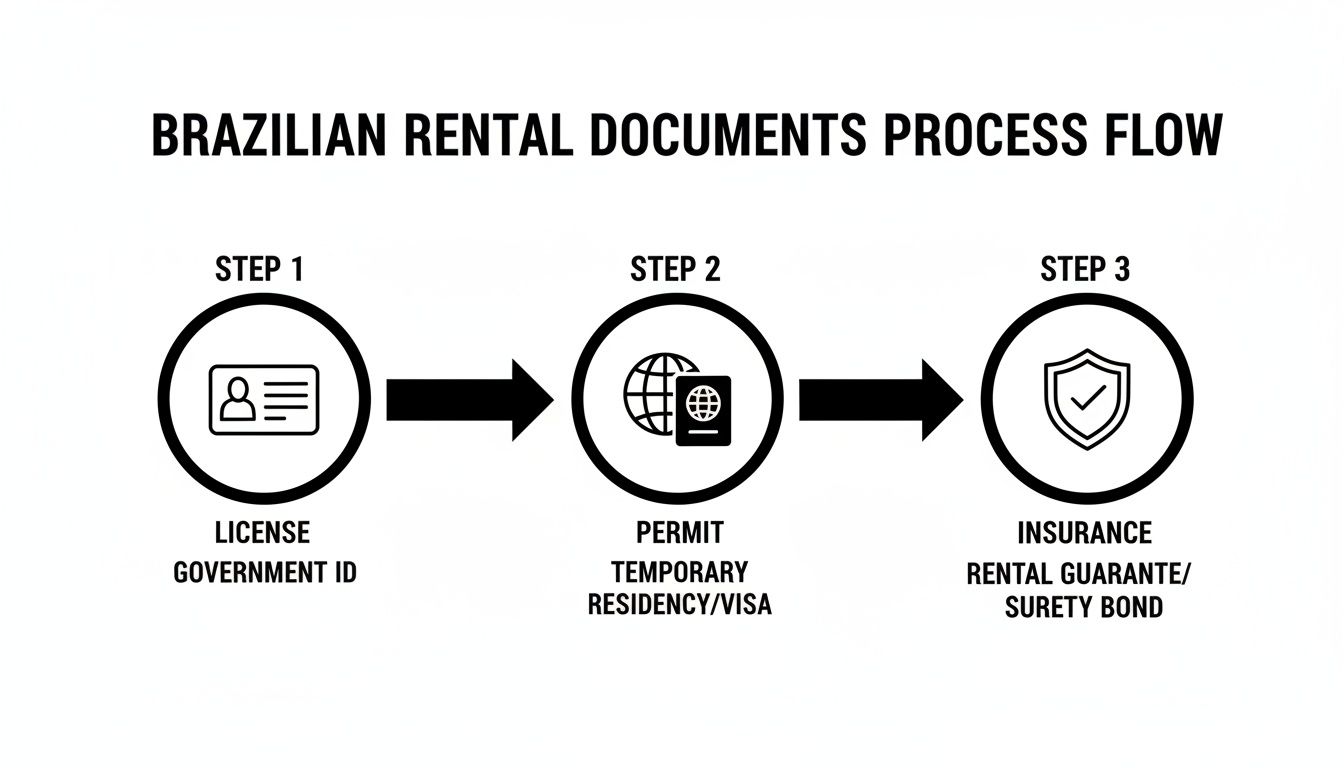
Making sure you have your license, passport, and insurance details handy will make the whole pickup process go much faster.
Navigating the Drop-Off Process
When it's time to head home, remember to leave yourself a little extra time for the drop-off. You're heading back to the rental company's lot, not the airport terminal departures area. Keep an eye out for road signs that say "Locadoras de Veículos" or "Rental Car Return." If you're feeling a bit lost in the maze of airport roads, this GRU airport map can be a lifesaver.
Pro Tip: The standard fuel policy here is "full-to-full." This means you get the car with a full tank, and you're expected to return it the same way. If you don't, the rental company will happily fill it up for you—at a wildly inflated price per liter. The easy way to avoid this is to find a gas station a few kilometers from the airport and top off the tank right before you pull into the return lot.
Mastering São Paulo's Roads Like a Local
Getting behind the wheel in São Paulo is a unique experience. After you've sorted out your car hire at São Paulo airport, the next step is getting familiar with the city's pulse and its specific driving rules. A little insider knowledge can make all the difference between a frustrating drive and a fantastic road trip.
Most Brazilian traffic laws will feel familiar. Seatbelts are mandatory for everyone, and you'll face hefty fines for using a mobile phone while driving. Keep an eye on the speed limit signs, as they can change pretty quickly from one neighborhood to another.
Navigating Tolls and Parking Safely
As you venture out, especially on the modern highways connecting São Paulo with the coast or countryside, you’ll run into toll roads, known locally as pedágios. It’s a good idea to keep some small bills of Brazilian Reais with you, as most toll booths still take cash.
The easier option? See if your rental car comes with an electronic payment tag, like Sem Parar or ConectCar. This little device lets you breeze through the automated lanes, and the toll charges are just added to your final rental bill.
When it comes to parking, a good rule of thumb is to always use secure, paid lots (estacionamentos), especially if you’re leaving the car overnight. And just like in any major city, stay aware of your surroundings—keep your doors locked and windows up when in slow-moving traffic.
The One Rule You Can't Ignore: São Paulo's 'Rodízio'
If there's one local driving regulation you absolutely must know, it's the Rodízio. This is São Paulo's vehicle restriction program, designed to combat the city's infamous traffic jams by limiting who can drive in the expanded central zone during peak hours.
It all comes down to the last digit of your car's license plate.
The city enforces this system during two key windows on weekdays:
- Morning Rush: 7:00 AM to 10:00 AM
- Evening Rush: 5:00 PM to 8:00 PM
Getting caught driving in the restricted zone during your car’s prohibited time will land you a significant fine. Before you even get the keys, it's smart to ask the rental agent about your car's license plate number so you can plan your drives into the city.
Here’s a simple breakdown of how the schedule works.
Understanding São Paulo's 'Rodízio' Vehicle Restriction
| Day of the Week | Restricted Final License Plate Digit(s) | Restricted Hours |
|---|---|---|
| Monday | 1 and 2 | 7 AM – 10 AM & 5 PM – 8 PM |
| Tuesday | 3 and 4 | 7 AM – 10 AM & 5 PM – 8 PM |
| Wednesday | 5 and 6 | 7 AM – 10 AM & 5 PM – 8 PM |
| Thursday | 7 and 8 | 7 AM – 10 AM & 5 PM – 8 PM |
| Friday | 9 and 0 | 7 AM – 10 AM & 5 PM – 8 PM |
Keep this chart handy. A quick glance before you head out can save you from an unexpected and completely avoidable penalty.
Knowing these local quirks is key. It even helps with budgeting—for example, understanding seasonal pricing and rental tips for GRU can lead to big savings. May is often the cheapest month, with daily rates around $25.39, a full 37% below the annual average. Combining that knowledge with a fair fuel policy ensures your São Paulo driving experience is as smooth and affordable as possible.
Thinking Twice About a Rental Car at GRU
Renting a car at Guarulhos Airport sounds like the key to freedom, but let's be real—in a megacity like São Paulo, that freedom can quickly turn into a major headache. Before you click "book" on that car hire at São Paulo airport, take a moment to consider if driving is actually the best move for your trip. Sometimes, the smarter play is to skip it altogether.
If you’re in town for business and your meetings are clustered around central hubs like Avenida Paulista or Faria Lima, a rental car can be more of a burden than a benefit. São Paulo's traffic is infamous for a reason; navigating it is a stressful, time-sucking nightmare. Then comes the hunt for parking, which is both incredibly scarce and expensive. You could easily waste more time looking for a spot than you spend in your actual meeting.
Why an Airport Transfer Often Makes More Sense
This is exactly where a dedicated GRU airport transfer service shines. Picture this: you land after a long flight, and instead of wrestling with your bags and trying to figure out a GPS, a professional driver is waiting for you right at arrivals. They handle your luggage, navigate the city's chaotic maze of roads, and get you straight to your hotel or meeting. For anyone on a tight schedule, that kind of reliability is priceless.
It's the same story for families. A professional driver takes care of everything. They’ll make sure the car seats, strollers, and all your suitcases fit, and you won't have to worry about a single wrong turn. You can focus on keeping the kids happy instead of stressing out in an unfamiliar city.
The true cost of a rental car goes way beyond the daily rate. It's the hours you lose stuck in traffic, the money you burn on parking, and the sheer mental exhaustion from dealing with the city’s complex road system and Rodízio driving restrictions.
Bottom line: if you're sticking to the city center or just want to kick off your trip without the stress, skipping the rental is often the wisest choice. For getting around the city itself, public transport is also a solid option. To see what that involves, check out our guide on how to use the metro from Guarulhos Airport and weigh your options.
Got Questions About Renting a Car at GRU?
Thinking through the logistics of a car hire at São Paulo airport always brings up a few questions. I've been through this process countless times, so let's clear up some of the most common things people ask before they arrive at GRU.
Can I Use My Driver's License from Back Home?
Yes, you almost certainly can. If you're visiting as a tourist, your home country's driver's license is valid for driving in Brazil for up to 180 days.
The only catch is that your license must use the Latin alphabet (the one you're reading now). If it's in a different script, like Cyrillic, Mandarin, or Arabic, you'll need to get an International Driving Permit (IDP) and carry both with you.
Can I Pick Up Here and Drop Off Somewhere Else?
Doing a one-way rental is a popular option, and yes, it’s widely available. You can easily pick up your car at Guarulhos and drop it off in another major city like Rio de Janeiro or even down south in Florianópolis.
Just know that rental companies, including big local players like Movida and Localiza, will add a "one-way fee" for this convenience. It's a standard charge, so make sure to look for it on your quote and factor it into your travel budget.
How Old Do I Need to Be to Rent a Car?
In Brazil, the minimum age to rent a car is 21.
However, if you're under 25, you'll almost always have to pay a daily "young driver surcharge." It’s a common industry fee, so don't be surprised when you see it on the bill. The exact amount varies from one company to the next.
Pro Tip: Keep some Brazilian Reais in cash with you for the toll roads (pedágios). While some rental cars are equipped with electronic toll passes, you'll find plenty of older highways, especially once you're outside the main city routes, that are cash-only.
Will They Take a Debit Card for Payment?
This is where a lot of travelers get tripped up. While you might be able to settle the final bill with a debit card when you return the car, you absolutely need a valid credit card in the main driver's name to pick it up.
They use this to place a security deposit hold—a temporary block of funds to cover any potential damages. It’s a mandatory step, and there’s no way around it.
Ready to skip the rental lines and enjoy a seamless arrival in São Paulo? Gru Airport Transfers offers reliable, professional, and stress-free transportation directly from the terminal to your destination. Book your ride today and start your trip the easy way.

