

So, you've just landed at São Paulo's Guarulhos Airport (GRU). Now comes the big question: rent a car or grab a transfer? This isn't just a simple choice; it’s about balancing the freedom of having your own wheels against the sheer intensity of navigating one of the world's most chaotic cities. Let's break down which option really makes sense for your trip.
Making The Right Choice For Your Arrival
The idea of renting a car is always tempting, isn't it? You get the freedom to explore São Paulo's surrounding areas, hit the coast on a whim, or just operate on your own schedule. For families lugging around car seats and extra bags, it can feel like a lifesaver.
But let's be real about driving in São Paulo. It’s not for the faint of heart. The traffic is legendary, the road system can be a maze, and then there's the rodízio—a vehicle restriction program that can sideline your car on certain days. For a lot of visitors, especially if you're here for business or sticking to the main city districts, the stress of driving, hunting for expensive parking, and general safety worries can quickly sour the experience.
This is exactly why a dedicated airport transfer often becomes the smarter play.
Cost Versus Convenience
Price is obviously a huge part of the equation. The rental scene at GRU fluctuates wildly with the seasons. You might see average daily rates around $56, but if you time it right, you can score a deal. May, for instance, is often the cheapest month, with prices plummeting to as low as $15 per day. That’s a world away from the peak rates you’ll see in December.
But don’t let a low daily rate fool you. The total cost of a rental car is a whole different story. You need to budget for:
- Fuel: Gas prices in Brazil can be a shock.
- Insurance: It's not optional; you need mandatory coverage.
- Tolls: The "Sem Parar" tag is a must for navigating the highways smoothly.
- Parking: Finding and paying for parking in central São Paulo can be a nightmare.
For many travelers, figuring out which path to take can be tough. Here’s a quick rundown to help you compare.
Rental Car vs. Airport Transfer: A Quick Comparison
| Feature | Car Rental at GRU | Gru Airport Transfers |
|---|---|---|
| Cost Structure | Variable (daily rate + fuel, insurance, tolls, parking) | Fixed, all-inclusive price. No surprises. |
| Convenience | Freedom to go anywhere, anytime. | Door-to-door service, no driving stress. |
| Best For | Day trips, exploring the coast, families with lots of gear. | Business travel, city-focused trips, first-time visitors. |
| Navigation | Your responsibility (GPS is a must). | Handled by an experienced local driver. |
| Hidden Fees | High potential for extra costs (fuel, tolls, parking fines). | None. The price you're quoted is the price you pay. |
| Arrival Experience | You'll have to find the rental desk, do paperwork, and inspect the car. | A driver meets you at arrivals. You just relax. |
At the end of the day, it all boils down to your specific travel plans.
A service like a Gru Airport Transfer offers a predictable, all-inclusive price. It completely removes the mental gymnastics of navigating a new city after a long flight, giving you a smooth and stress-free start.
If your itinerary is packed with excursions far outside the city, a rental might be the perfect fit. But if you're mainly sticking to São Paulo itself, the sheer ease and safety of a dedicated Guarulhos airport transfer often wins out as the most sensible choice.
Booking Your Car and Getting Your Paperwork in Order
Nailing your car rental Sao Paulo Guarulhos Airport experience really boils down to one thing: being prepared. The single biggest mistake I see travelers make is thinking they can just show up and grab a good deal at the counter. That’s a recipe for steep prices and slim pickings, especially if you’re traveling during a busy season.
My advice? Book your car online, and do it at least a few weeks before you fly. If your trip is during a peak time like December or Carnaval, you’ll want to book one or even two months out. Use a good comparison site to see what’s available from the big names at GRU—you'll mainly see Localiza, Movida, and Unidas—and compare them side-by-side.
My Two Cents: Keep a close eye on the insurance package when you book. The basic Collision Damage Waiver (CDW) is usually standard, but it often comes with a hefty deductible. For a little extra per day, you can usually get that deductible reduced way down, which is a small price to pay for peace of mind on São Paulo's chaotic roads.
What Kind of Car Should You Get?
The car you pick can genuinely make or break your trip. São Paulo's streets can be incredibly narrow and jammed, and parking? Let's just call it a competitive sport.
That's why a compact car like a Fiat Mobi or a Hyundai HB20 is almost always the smartest bet if you're flying solo or with a partner. They sip gas, are a breeze to weave through traffic, and you can squeeze them into parking spots you'd never manage with a bigger car.
Of course, if you've got the family in tow or you’re planning long drives down the coast, a sedan or an SUV will give you the comfort and trunk space you need. Just be ready for the extra stress of maneuvering a larger vehicle around the city.
The Documents You Absolutely Cannot Forget
Showing up at the rental desk unprepared is the fastest way to start your trip with a headache. Brazilian rental companies are sticklers for paperwork, and if you’re missing even one thing, they won't hand over the keys. I always keep everything in one folder so it's ready to go.
Here's your checklist. Don't leave for the airport without these:
- Your Driver's License: It has to be valid, from your home country, and definitely not expired.
- International Driving Permit (IDP): Honestly, some agents might not even ask for it. But it's technically a legal requirement for foreigners to drive in Brazil, and if you get pulled over, the police will want to see it. Get this in your home country before you leave.
- Your Passport: This is your main photo ID.
- The Credit Card You Booked With: This is non-negotiable. The card must be in the primary driver's name and have a high enough limit for the security deposit. This deposit can be anywhere from R$700 to R$5,000 (or more), depending on the car and insurance you choose. Debit cards are not accepted for the security hold.
Navigating The Car Rental Pickup Process At GRU
Once you’ve collected your bags and cleared customs at GRU, it's time to find your rental car counter. The good news is that the major players—Localiza, Movida, Unidas, and others—have desks right inside the arrivals halls of both Terminal 2 (T2) and Terminal 3 (T3).
You won’t need to trek across the airport with all your luggage. To get your bearings ahead of time, it's always a smart move to look at a GRU airport map to see exactly where the agencies are located.
After you've shown your documents and signed the final paperwork, they'll hand over the keys. But don't race to the car just yet. The agent will point you toward the rental car section of the parking garage, and this next part is arguably the most important step of the entire rental: the vehicle inspection. Seriously, don't rush this.
The All-Important Vehicle Inspection
This is your chance to protect yourself from being blamed for damage you didn't cause. Before you even put your bags in the trunk, do a slow, methodical walk-around.
Use your phone to take pictures or a video of every single scratch, dent, and scuff you can find, no matter how tiny it seems. Focus on common problem areas like bumpers, door edges, and wheels. It might feel a bit over-the-top, but this documentation is your proof if any issues come up later.
Besides the cosmetic stuff, make sure you check a few functional details:
- Tire Condition: Give the tires a quick look. Is the tread decent? Do they look properly inflated? The last thing you want is a tire issue on one of São Paulo's busy highways.
- Fuel Policy Confirmation: Most rental companies in Brazil operate on a "full-to-full" basis. Glance at the fuel gauge and make sure it's pointing to 'F' before you drive off.
- 'Sem Parar' Tag: Double-check with the agent that the electronic toll tag on the windshield is active and working. Trust me, navigating tolls manually is a hassle you don't need.
This quick flowchart sums up the basic journey from booking to driving away.
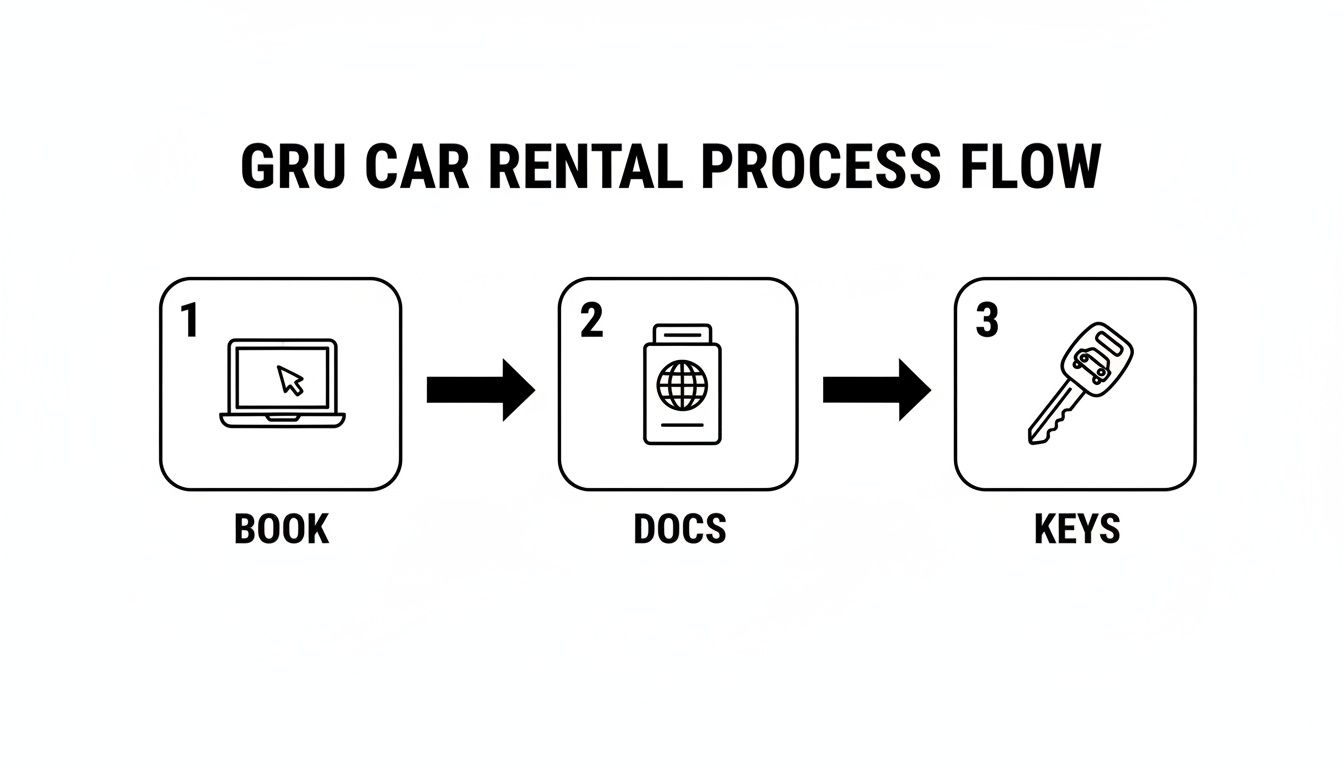
As you can see, having your reservation and documents in order is half the battle, making the process at the counter much smoother.
Handling Upselling And Finalizing The Pickup
It’s almost a guarantee that the rental agent will try to upsell you on something, whether it’s a bigger car or extra insurance coverage. If you're happy with what you booked online, be prepared to give a firm but polite "no, thank you." They are good at their job and might mention local driving risks, but if your research is done and you have adequate coverage, stick to your plan.
To give you a ballpark, a standard medium-sized car often goes for around $38 per day, with SUVs costing a bit more. Having these numbers in mind helps you decide if an "upgrade" offer is a genuine deal or just a sales tactic.
Once the inspection is done and you've navigated any sales pitches, you're set. Take a minute in the driver's seat to adjust your mirrors, connect your phone, and plug your destination into the GPS. Then, take a deep breath and get ready to merge into the exhilarating, and sometimes chaotic, flow of São Paulo traffic.
Navigating São Paulo: A Practical Guide to Insurance, Tolls, and Driving
Once you’ve collected your car rental from Sao Paulo Guarulhos Airport, you’re about to dive into one of the most dynamic and demanding driving environments in the world. Being truly prepared here isn’t just about having a GPS—it’s about understanding the local rules of the road, the nuances of insurance, and the city's unique rhythm.
Let's start with insurance. In Brazil, your rental agreement almost always includes a basic level of Collision Damage Waiver (CDW). The catch? It usually comes with a sky-high deductible, meaning you could be on the hook for a significant sum if an accident happens. For genuine peace of mind, it’s a smart move to opt for a more comprehensive insurance package that brings that deductible way down.
You might be thinking your premium credit card has you covered, and it might. However, it's absolutely critical to confirm if their coverage is considered primary in Brazil and if it meets the rental agency's specific requirements. A quick call to your credit card company before you travel can save you a mountain of stress and money at the rental desk.
Mastering Tolls With Sem Parar
The highways branching out from GRU are dotted with toll booths. The most painless way to deal with them is with a Sem Parar tag, which is an electronic transponder you'll find on the windshield. This little device lets you breeze through dedicated express lanes, with the toll automatically charged to an account linked to the rental agency.
Without one, you're stuck in the cash lanes, fumbling for change at every booth. This can lead to serious delays, especially during rush hour. Before you even pull out of the airport garage, double-check with the agent that the Sem Parar tag in your car is active. It’s a tiny step that makes a massive difference to your travel time.
Driving in São Paulo demands a defensive mindset. Expect the unexpected—from motorcyclists weaving between lanes (a practice known as "corredores") to abrupt stops in traffic. Your best defense is to keep a safe following distance and stay hyper-aware of your surroundings at all times.
Surviving São Paulo City Driving
Driving within the city itself brings its own unique set of challenges, the biggest one being the rodízio veicular. This is a traffic management program designed to reduce congestion by restricting vehicle access to the city's central expanded area based on the last digit of your license plate.
Here’s the general breakdown of the rodízio:
- Plates ending in 1 and 2: Restricted on Mondays
- Plates ending in 3 and 4: Restricted on Tuesdays
- Plates ending in 5 and 6: Restricted on Wednesdays
- Plates ending in 7 and 8: Restricted on Thursdays
- Plates ending in 9 and 0: Restricted on Fridays
These restrictions are enforced during peak morning (7-10 AM) and evening (5-8 PM) hours. Getting caught violating the rodízio will land you a hefty fine. When you pick up your car, ask the agency about the license plate number so you can plan your city driving accordingly.
Parking is another major headache—it's both scarce and expensive. If you plan on driving into the city, it’s also a good idea to research the typical parking costs at Guarulhos airport for when you return the car. And for any longer trips you might be planning, getting some tips on smart road trip packing can make your journey that much smoother.
When to Skip the Rental Car and Get an Airport Transfer Instead
Having your own wheels with a car rental at Sao Paulo Guarulhos Airport definitely has its perks, but let's be realistic—it's not always the best move. For many trips, especially your first time here, a dedicated airport transfer is not just simpler, it’s genuinely the smarter, more practical choice.
Think about it. You’ve just spent hours on a plane, you're tired, and your internal clock is all mixed up. The last thing you want is to decipher rental agreements in another language, hunt for your car in a massive garage, and then dive headfirst into São Paulo's infamously chaotic traffic. That's a surefire way to start your trip stressed out.
Is a Rental Car Really Worth the Hassle?
For certain situations, a pre-booked transfer just makes more sense. I’ve seen it time and time again—travelers breathe a sigh of relief when they realize they made the right call.
A transfer is almost always the clear winner if you fall into one of these camps:
- You're Arriving Late at Night: Landing on a red-eye is draining. Do you really want to add navigating dark, unfamiliar roads to the mix? Having a driver waiting for you is a huge comfort and a major safety plus.
- You're Here for Business: If you're in São Paulo for work, your time is money. A professional service like Gru Airport Transfers gets you to your hotel or meeting efficiently. You can use the ride to prep or decompress, arriving sharp and ready, not frazzled from fighting traffic.
- You're Traveling with Family: Anyone who's wrangled kids, car seats, and a mountain of luggage knows the struggle. A transfer service means you have a helping hand with the bags, and everyone can pile into a safe, clean vehicle without a meltdown.
The convenience factor is huge, but it's not just about avoiding stress. The "great deal" you found on a rental car can quickly become a money pit once you're on the ground.
The Hidden Costs of Renting a Car in São Paulo
That low daily rate you booked online? It’s just the starting point. The real cost of driving yourself around São Paulo for a few days often tells a very different story.
Don't get fooled by the sticker price of a rental car. With an airport transfer, you get a single, all-in price. No surprise charges for fuel, tolls, parking, or unexpected fines. You know exactly what you're paying upfront.
Let’s talk about the extra expenses that almost always catch visitors off guard:
- Fuel: Gasoline prices in Brazil can be a real shock if you're not prepared, easily adding a hefty chunk to your daily budget.
- Parking: Good luck finding cheap (or any) parking in central São Paulo. Secure spots are expensive and can cost a small fortune, especially overnight at hotels.
- Tolls: All the main highways leading in and out of the city are toll roads. That Sem Parar tag is convenient, but every "beep" adds to your final bill.
- Fines: It's incredibly easy to accidentally drive into a rodízio restricted zone on the wrong day or commit a minor traffic violation. You might not even know you did it until a big fine shows up on your credit card weeks later.
When you add it all up, the fixed, predictable fee of a professional transfer often looks much more appealing. It’s an investment in a safe, stress-free start to your time in Brazil.
Your Top Questions About Renting a Car at GRU Answered
Even after you've compared prices and picked a car, a few nagging questions can pop up. Let's tackle the most common ones I hear from travelers, so you can book your rental at São Paulo's Guarulhos Airport with total confidence.
Do I Really Need an International Driving Permit (IDP)?
Short answer: Yes. You absolutely should get one.
You might hear stories from other travelers who got by with just their home country's license, especially if it's in a Roman alphabet. But honestly, that’s just rolling the dice. Brazilian law is clear that foreign drivers need an International Driving Permit (IDP) to accompany their original license.
The real issue isn't the rental counter—it's what happens if you get pulled over. The traffic police will almost certainly ask for your IDP, and not having one can lead to fines and a lot of unnecessary hassle. For the small cost and effort it takes to get an IDP before you leave home, the peace of mind is well worth it. It’s the smart, safe play.
What Hidden Fees Should I Watch Out For?
Nothing sours a rental experience faster than a surprise charge on your final bill. The initial quote can look great, but a few common "gotchas" can inflate the price. Keep an eye out for these.
- Airport Surcharges: There’s often a specific fee tacked on just for the convenience of picking up your car right at GRU.
- Pricey Extras: Need a GPS or a child seat? Renting them from the agency can be shockingly expensive. Using your phone for navigation is almost always a better deal, and if you're traveling with kids, bringing your own car seat could save you a small fortune.
- The Refueling Trap: Most policies are "full-to-full." If you don't bring the car back with a completely full tank, the rental company will fill it for you—at a wildly inflated price per liter.
- Insurance Upselling: Be prepared for a hard sell on premium insurance at the counter. Know what your credit card covers before you arrive. Many premium cards offer primary rental insurance in Brazil, which could mean you don't need the agency's expensive add-ons.
My best advice? Take a deep breath and carefully read every line of the final rental agreement before you sign. Question any charge you don’t understand. A few minutes of diligence at the counter can save you a massive headache later.
How Tough Is It to Park in São Paulo?
Let's be direct: parking in São Paulo is a nightmare. It’s both a challenge and a major expense.
In busy areas like Paulista Avenue, Itaim Bibi, or the trendy Vila Madalena, finding a spot on the street is a rare victory. Most on-street parking is managed by a digital system called 'Zona Azul', which requires a specific app and has strict time limits.
Your other option is a private parking garage, or estacionamento. They’re everywhere, but they are not cheap, often charging hefty hourly rates that add up fast. If your hotel doesn’t offer guaranteed parking, this can become a significant, stressful part of your daily budget. For trips centered on exploring the city itself, a pre-booked transfer often makes way more sense.
Is Driving in São Paulo Safe?
Driving here requires your full attention, 100% of the time. The traffic is as intense as its reputation suggests, and the local driving style can feel aggressive and unpredictable if you’re not used to it. While the main highways (rodovias) are generally well-maintained, city streets can be a minefield of potholes and other surprises.
As for personal safety, you need to be smart. Always drive with your doors locked and windows up, especially when you're stopped in traffic. And never, ever leave valuables visible inside the car. If you're not an experienced, confident driver comfortable with chaotic conditions, or if you simply want to avoid the stress, hiring a professional driver is a much safer and more relaxing way to get around.
For a seamless, safe, and predictable travel experience from the moment you land, consider booking with Gru Airport Transfers. We eliminate the uncertainties of car rentals so you can focus on your trip, not the traffic. Book your ride today

