

Let's be honest, staring at a taxi meter in a new city can be one of the most stressful parts of traveling. A cab cost estimator is the perfect antidote to that fare anxiety. Think of it as a financial GPS for your ride, figuring out your trip's price before you even open the car door. It completely removes the stress of watching that meter tick up, especially when you're navigating a city famous for its traffic jams.
Why You Need a Cab Fare Estimator

Trying to get your bearings in a massive city like São Paulo, especially right after a long flight into GRU Airport, can be overwhelming. The very last thing you want is a surprise bill from your taxi ride. This is exactly where a reliable fare estimator proves its worth, turning what could be a stressful journey into a predictable, manageable part of your trip.
It's simple, really. You wouldn't book a flight without knowing the price, so why treat your ground transportation any differently? An estimator gives you a clear financial picture by pulling in all the crucial details—distance, estimated travel time, and the standard local rates.
The Power of Price Certainty
For anyone traveling to or from a major international airport, that predictability is everything. The global taxi market is expected to hit a staggering USD 292.60 billion by 2025, fueled by the return of international travel. Here in Brazil, São Paulo’s GRU Airport alone sees over 15 million international passengers every year. Many of them run straight into the city's infamous traffic, which can easily tack hours onto a trip. You can dive deeper into these trends with these global taxi market insights.
An accurate estimate puts you back in control of your travel budget. It lets you compare different options, plan your spending, and sidestep the all-too-common trap of overpaying for a ride.
In this guide, we'll pull back the curtain on how these tools work. We’ll look at the fundamental pieces of any taxi fare, helping you understand what goes into the final number on your receipt. Let’s start with a quick breakdown of what a cab cost estimator is actually calculating.
Key Components of Your Cab Fare Estimate
This table breaks down the main elements that contribute to your final cab fare, helping you understand where the costs come from.
| Fare Component | What It Covers | Example at GRU Airport |
|---|---|---|
| Base Fare | The initial, fixed charge for just starting the ride. | A standard starting fee for all official airport taxis. |
| Distance Rate | The cost calculated per kilometer or mile traveled. | The charge for the actual journey from GRU to your hotel. |
| Time Rate | Charges for time spent sitting still in traffic or at stops. | Extra costs added during São Paulo's notorious peak traffic hours. |
Knowing these three core parts is the first step to truly understanding your fare and avoiding any surprises.
The Building Blocks of Your Taxi Fare
Have you ever watched a taxi meter tick up and wondered what’s really going on behind the numbers? It’s not just random; there's a specific formula at work. Getting a handle on these core components is the key to using a cab cost estimator like a pro and avoiding any nasty surprises at the end of your ride.
Think of the final fare like a simple recipe. It has a few main ingredients that, when combined, create the total cost. From the moment you hop in until you step out, each part of the journey adds to that final number. Let's pull back the curtain and see how it all works.
The Starting Point: Your Base Fare
Every single taxi ride starts with a base fare. This is a flat fee you're charged the second the meter is switched on. It's like the initial service charge for hailing the cab—you pay it just for getting in, before the car has even pulled away from the curb.
This fixed amount covers the driver's basic operational costs and is typically regulated by local authorities. Here in São Paulo, for instance, the standard base fare is BRL 5.40. It’s the foundation of your total fare, with everything else built on top.
The Journey Itself: Distance and Time Rates
Once your trip is underway, the meter starts calculating the bulk of your fare based on two key variables: how far you go and how long it takes. A good cab cost estimator needs to weigh both of these to give you a realistic quote.
The Distance Rate: This one is easy to understand. It’s simply the price per kilometer (or mile) traveled. In São Paulo, this rate hovers around BRL 3.30 per kilometer. The farther you go, the more this adds up.
The Time Rate: This is how the meter accounts for traffic. When your taxi is stuck at a red light or crawling along in gridlock, this rate kicks in to compensate the driver for their time.
A common myth is that you're charged for distance or time, but not both. The truth is, modern taxi meters are smart. They're programmed to charge for whichever is generating more cost at any given moment—distance when you're cruising, and time when you're stopped.
This is a huge deal in a city famous for its congestion. A 20-kilometer trip can have a wildly different price tag if you’re traveling at 2 AM versus smack in the middle of the 5 PM rush hour.
It's also worth noting how much taxi costs can vary worldwide. According to a global taxi service ranking, a quick 3km ride in Bern, Switzerland, could set you back a shocking £14.78, while the same trip in Cairo, Egypt, is just £0.93. This massive difference shows why having local cost knowledge is so important, especially when you’re heading to or from a major hub like São Paulo's GRU.
These three ingredients—the base fare, the distance rate, and the time rate—are the heart of nearly every taxi fare calculation on the planet. But they aren't the whole story. Other charges can and do appear on the final bill, and we’ll get into those next.
The "Extras": Factoring in Surcharges, Airport Fees, and Tolls
So, we've covered the basic building blocks of a cab fare—the base rate plus the charges for distance and time. But if you stop there, you’re missing a big piece of the puzzle. The final price you pay almost always includes a few extra items, and this is where a quick guess can really differ from the final bill.
Think of these as situational costs. They pop up depending on where you're going, what time it is, or the specific route your driver takes. A good cab cost estimator has to be smart enough to anticipate these.
What Are Surcharges, Really?
Surcharges are simply extra fees for specific circumstances. They aren't part of the ticking meter but are added on at the end. They can feel like a surprise if you aren’t aware of them.
Here are a few you'll likely run into:
- Late-Night or Holiday Rates: In Brazil, you'll often hear the term "Bandeira 2." This is an officially approved higher rate that kicks in during late-night hours or on public holidays to give drivers extra incentive.
- Luggage Fees: Have a lot of bags? Some services might add a small, fixed fee for each piece of luggage, especially if it's large or bulky.
- Extra Passenger Fees: If you're traveling with a larger group, you might see a small surcharge once you go over the standard number of passengers.
These are perfectly normal charges, but knowing about them ahead of time makes all the difference. It's one of the main reasons a pre-booked service with a fixed price is so appealing—it folds all of these possibilities into one simple, upfront quote.
Don't Forget Airport Fees and Tolls
When your trip involves an airport like GRU, you can pretty much count on two more costs: airport fees and road tolls. These aren't just random charges the driver invents; they are direct costs passed on to the passenger.
The airport fee is a charge from the airport authority itself, which allows commercial vehicles to pick up passengers on its property. Your transfer service pays that fee and includes it in your fare. Likewise, the major highways connecting GRU to São Paulo are dotted with toll booths, and those costs are also added to your trip.
The taxi business is huge on a global scale—China alone is expected to bring in USD 54 billion by 2025. This creates some pretty complex pricing, especially in busy metro areas. São Paulo is a perfect example. With GRU Airport seeing over 35 million passengers a year, a typical trip into the city can easily reach around BRL 250 (USD 45) once you add up all the fees. You can dive deeper into these global taxi statistics to see the bigger picture.
This is where a service like Gru Airport Transfers really shines. We calculate all these variables—tolls, airport fees, and potential surcharges—and roll them into a single, fixed price. You know exactly what you're paying before you even get in the car, which means no surprises and a much more relaxing start to your journey.
See How Your GRU Airport Fare Is Calculated
Knowing the theory is one thing, but seeing it in action with real numbers is where it all clicks. Let's put the concepts aside and walk through a few real-world fare estimates for popular routes from GRU Airport. This will show you exactly how a cab cost estimator crunches the numbers for your trip.
We'll look at two of the most common destinations for travelers arriving in São Paulo: the iconic Avenida Paulista and the bustling business district of Itaim Bibi. By breaking down each trip, you’ll see firsthand how distance, traffic, and those extra fees all come together to determine your final bill.
Example 1: GRU Airport to Avenida Paulista
Avenida Paulista is a massive cultural and financial hub, making it a top destination for both tourists and business travelers. The journey from GRU Airport is about 28 kilometers.
Let's break down how a typical metered fare could look:
- Base Fare: The meter starts ticking from a fixed BRL 5.40.
- Distance Cost: At roughly BRL 3.30 per kilometer, the distance alone adds up to BRL 92.40.
- Tolls & Fees: You can expect around BRL 20 for highway tolls and the standard airport pickup fee.
Just with these basics, the total is already over BRL 117. But this estimate doesn't account for the biggest wild card in São Paulo: traffic. On a good day with light traffic, you might only add a little extra for time. During rush hour, though, that same trip could easily rack up an extra BRL 40-60 in time-based charges, pushing the final fare well past BRL 160.
Example 2: GRU Airport to Itaim Bibi
Next up, let's imagine you're heading to Itaim Bibi, a key corporate neighborhood about 35 kilometers from the airport. The math is similar, but the longer distance makes every variable count even more.
- Base Fare: Again, you start at BRL 5.40.
- Distance Cost: The 35km journey brings the distance charge to approximately BRL 115.50.
- Tolls & Fees: The tolls and airport fee stay consistent at around BRL 20.
Without traffic, you’re already looking at a fare close to BRL 141. Now, throw in São Paulo's notorious rush hour, and the time-based charges for this longer ride could absolutely skyrocket, potentially adding another BRL 60-80 to your bill. All of a sudden, what should be a straightforward trip becomes a very expensive gamble.
The real takeaway here is the massive gap between a best-case and worst-case scenario. The unpredictability of a metered fare means you could pay anywhere from BRL 120 to BRL 220 for the exact same route, depending entirely on when you travel.
This next diagram really drives home how those extra costs—surcharges, airport fees, and tolls—can pile up.
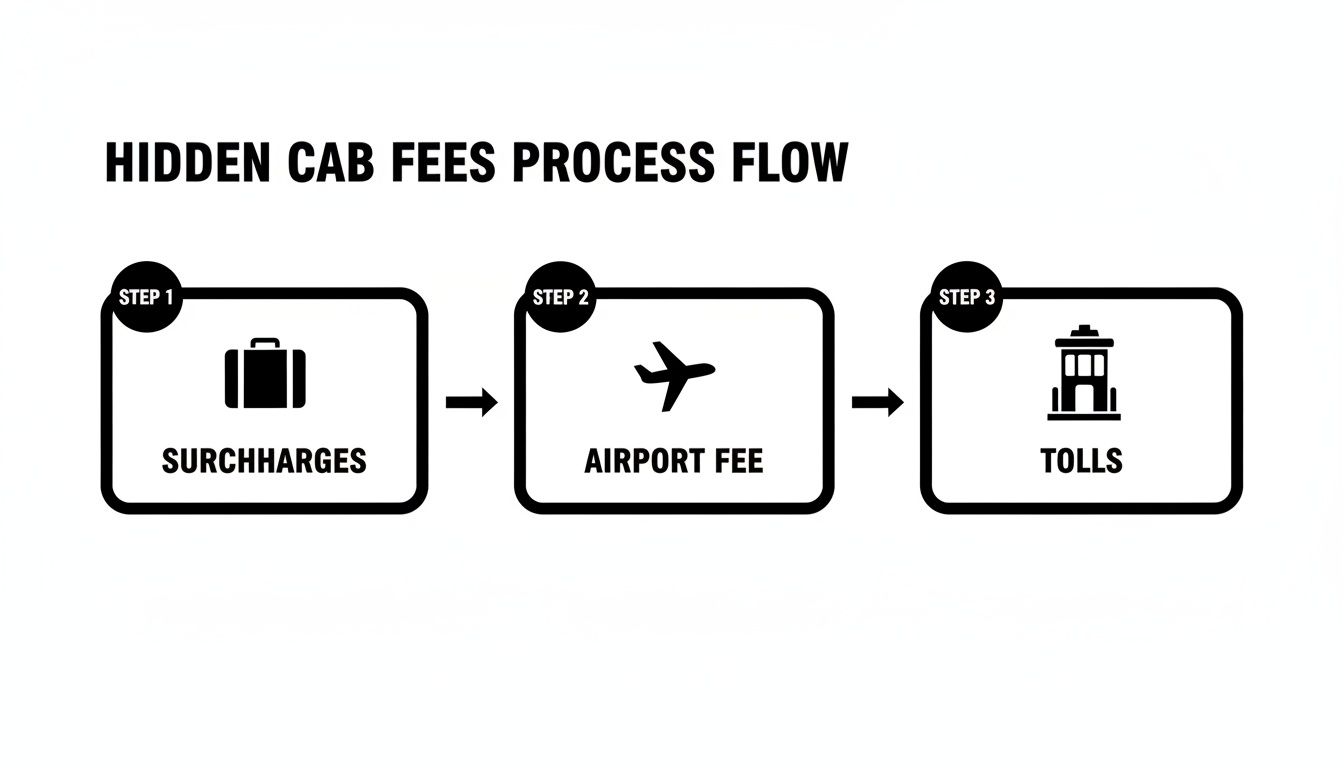
It’s a great visual reminder that the price you see on the meter when you start is often just the beginning.
Estimated GRU Fare Comparison: Metered Taxi vs. Fixed Rate
Seeing the numbers side-by-side is the best way to understand the value of knowing your fare upfront. The uncertainty of a running meter is exactly what a pre-booked service is designed to solve. This table gives you a clear comparison of what you might pay.
| Route from GRU | Estimated Metered Fare (Peak Traffic) | Estimated Metered Fare (Off-Peak) | Gru Airport Transfers Fixed Quote |
|---|---|---|---|
| Avenida Paulista | BRL 160 – BRL 180 | BRL 120 – BRL 140 | One guaranteed price |
| Itaim Bibi | BRL 200 – BRL 220 | BRL 140 – BRL 160 | One guaranteed price |
As you can see, a fixed-rate service from Gru Airport Transfers swaps that unpredictability for total peace of mind. You get one clear, all-inclusive price when you book. It doesn't matter how bad the traffic gets or if there are unexpected detours—your fare is locked in. This gives you complete control over your budget and a much more relaxing start to your time in São Paulo. You can learn more about how a pre-booked taxi from GRU airport eliminates these variables completely.
Tips for Getting a More Accurate Fare Estimate
Using a cab fare estimator is a great first step, but remember the old rule: garbage in, garbage out. The accuracy of the number you get is only as good as the information you put in. A vague request will get you a vague, and likely inaccurate, price.
To get a number you can actually count on, you need to be specific. Think of it like punching an address into a GPS—the more precise you are, the better the route. The same logic applies here.
Be Specific with Your Details
Giving the estimator exact information is the single best thing you can do. A rough guess just won't work when every single kilometer and minute on the road can tick the final price up. Precision is your friend.
Here's what you should zero in on:
- Provide Exact Addresses: Don't just type in "Avenida Paulista." Use the full, specific street address of your hotel or final stop. This helps the calculator clock the real distance, not just a trip to the general neighborhood.
- Account for Passengers and Luggage: Traveling with a family of four and a mountain of bags? That probably means you'll need a larger vehicle, like an SUV or a van. Mentioning this upfront allows the estimator to factor in any potential surcharges for a bigger car.
- Factor in the Time of Day: São Paulo traffic is a beast. Try running your estimate for a peak time (say, 5 PM on a weekday) and an off-peak time (like 10 AM). This will show you a realistic price range and prepare you for how much a traffic jam can really cost.
Know the Difference Between an Estimate and a Quote
This is a really important distinction, and understanding it can save you from a nasty surprise when it's time to pay. The number you see on a typical cab cost estimator is just that—an estimate. It's a sophisticated guess based on the available data, but it's not set in stone.
An estimate is a moving target that can change based on real-time factors like sudden traffic jams or a last-minute detour. A fixed quote, on the other hand, is a guaranteed price. It's locked in and won't change.
This is exactly why pre-booking a transfer service gives travelers so much peace of mind. While many people wonder if they can schedule a rideshare ahead of time, it's crucial to know that even those pre-scheduled rides can see price changes. You can learn more about the details by reading up on scheduling an Uber in advance and seeing how it differs from a truly fixed fare.
With a service like Gru Airport Transfers, the price you're quoted is the price you pay. Period. It gives you complete certainty for your travel budget, with no hidden fees or last-minute surcharges.
Locking in Your Price with a Fixed Quote
While a fare estimator gives you a solid ballpark figure, it's important to remember it’s still just that—an estimate. The final cost of a metered ride can easily creep up due to unexpected traffic jams or a last-minute detour. This is where a pre-booked service with a fixed quote completely changes the game.
Opting for a fixed price takes the guesswork out of your travel budget. It’s the difference between watching the meter tick up anxiously in São Paulo traffic and simply enjoying the ride, knowing the price is already set. For anyone who values predictability, from business travelers on a tight schedule to families starting their vacation, it’s a much smarter way to travel.
Why a Guaranteed Fare is Better
A fixed quote is simple: the price you are quoted is the final price you will pay. Period. All the usual variables that can inflate a metered fare are already calculated and included, giving you a totally transparent booking from the start.
Here’s what that really means for you:
- Zero Surprise Fees: Any potential tolls, airport surcharges, or even luggage fees are bundled into the one upfront price.
- Budget with Confidence: You can lock in your ground transportation costs to the exact cent, which makes planning your overall trip budget a breeze.
- Total Peace of Mind: When your fare is guaranteed, you can sit back and relax. It doesn't matter if the traffic is a nightmare; your cost won't change.
By securing a fixed price, you trade the gamble of a metered fare for the guarantee of a stress-free journey. Your focus stays on your trip, not on the meter.
Getting your guaranteed rate is straightforward. When you need a dependable transfer aeroporto Guarulhos, a quick online quote is all it takes to arrange your ride with complete price transparency from the moment you click "book."
Got Questions About Cab Fares? We've Got Answers
Even with a great cab cost estimator, a few questions always pop up. Getting clarity on the little details is the key to a smooth, predictable ride, so let's tackle some of the most common things travelers ask before they book.
Is a Tip Included in My Cab Cost Estimate?
Great question. The short answer is no, your initial fare estimate almost never includes a tip.
Tipping etiquette varies, but here in Brazil, a 10% gratuity is a standard and much-appreciated way to say thanks for great service. When you get a fixed quote from a service like Gru Airport Transfers, the price you see is for the ride itself. The tip is always left to your discretion.
How Accurate Are Online Cab Fare Estimators?
The best ones are impressively accurate, pulling in real-time traffic data and the latest local fare structures. But at the end of the day, they are still "estimates." Unforeseen road closures or a sudden traffic jam can throw them off.
For 100% certainty, nothing beats a "fixed quote." It locks in your price ahead of time, so you know exactly what you'll pay, no matter what the traffic does. No surprises, guaranteed.
What Is Surge Pricing and How Can I Avoid It?
Ah, surge pricing. It's that frustrating moment when ride-hailing apps jack up the prices because of high demand, like during rush hour, a big event, or bad weather.
The single best way to avoid it? Pre-book your ride with a transfer service that offers fixed, all-inclusive prices. That way, your rate is agreed upon upfront and never subject to those crazy surge multipliers.
Answering common questions like these is a huge part of building trust with customers. For travel agencies looking to handle these inquiries efficiently, check out these insights on Reasons to Use an FAQ Chatbot for Your Travel Agency.
Ready for a stress-free ride with a price you can count on? Get your instant, all-inclusive quote from Gru Airport Transfers today and travel with complete confidence. Book your transfer now!

