

When you ask which airport is the biggest in Brazil, there’s one clear-cut answer: São Paulo/Guarulhos International Airport (GRU). It's not just another airport; it's the nation's primary international gateway, a true behemoth that dwarfs every other hub in the country in terms of sheer passenger numbers.
GRU by the Numbers: A Clear Winner
To really get a feel for GRU's scale, you have to look at the numbers. It isn't just a little busier than the rest—it operates in a league of its own. The constant flow of travelers through its terminals cements its status as one of South America's most critical mega-hubs.
In a recent year, São Paulo/Guarulhos handled an incredible 43,580,962 passengers. This wasn't just a static number; it represented a 6% jump from the year before, showing just how central GRU is to both Brazilian and international travel.
This chart drives the point home, visually stacking up GRU against Brazil’s other major airports.
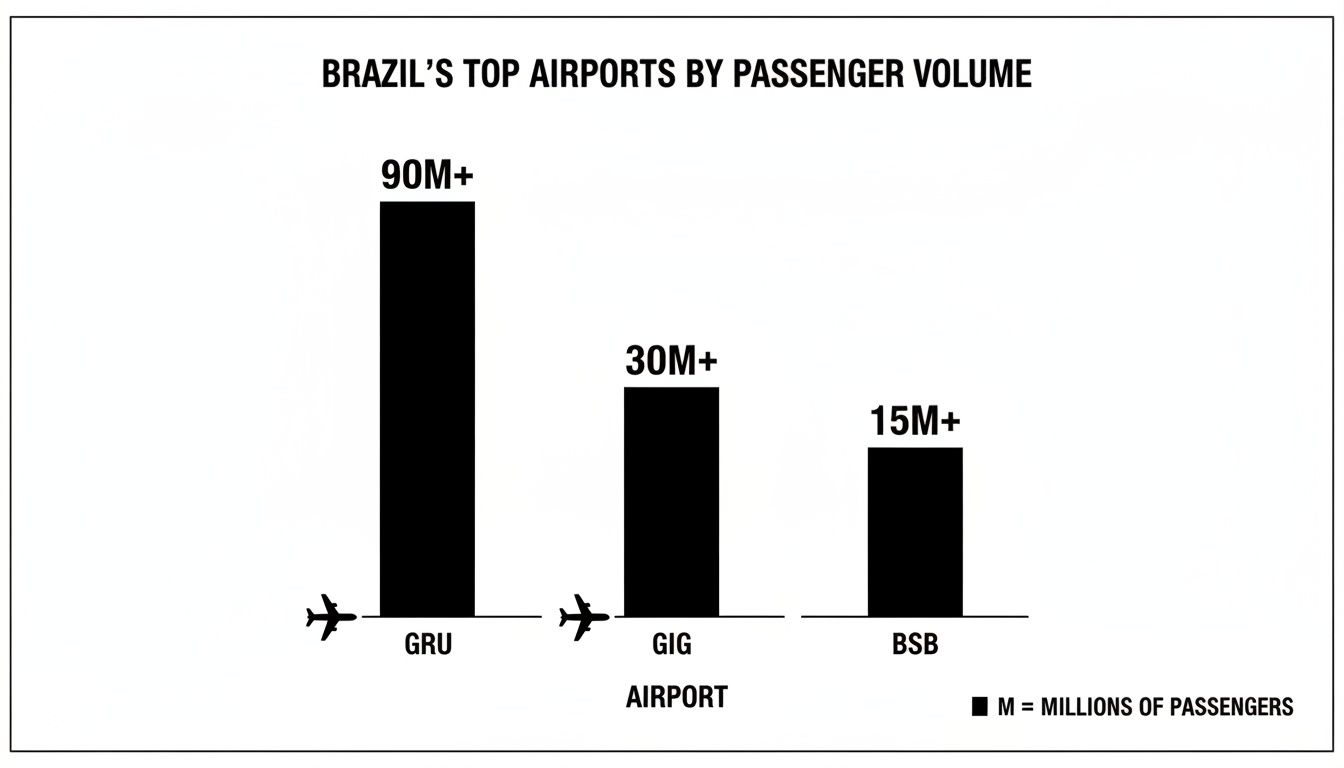
As you can see, GRU isn't just leading the pack; it's handling multiples of the passenger traffic seen at other vital hubs like Rio de Janeiro (GIG) and Brasília (BSB).
Comparing the Top Contenders
To provide a clearer picture, this table compares the passenger traffic for Brazil's key airports.
Brazil's Top Airports at a Glance by Passenger Volume
| Airport | IATA Code | City | Annual Passengers (Approx.) |
|---|---|---|---|
| São Paulo/Guarulhos | GRU | São Paulo | 43.5 million |
| Rio de Janeiro/Galeão | GIG | Rio de Janeiro | 13.5 million |
| Brasília International | BSB | Brasília | 13.3 million |
The data makes it obvious: while other airports are essential to Brazil's national infrastructure, none come close to GRU's sheer volume.
Here’s a quick breakdown of their roles:
- São Paulo/Guarulhos (GRU): The undisputed champion. This is the main port of entry and exit for most long-haul international flights.
- Rio de Janeiro/Galeão (GIG): A major international gateway, especially for tourists flocking to Rio's famous beaches, but its traffic is significantly lower than GRU's.
- Brasília (BSB): A crucial domestic hub. Its central location in the nation's capital makes it a key connection point for flights crisscrossing Brazil.
Knowing this hierarchy is a huge help for anyone planning a trip. If you're heading into the country's main hub, our guide to the São Paulo Airport can help make your arrival and departure a breeze.
What Makes an Airport the “Biggest”?
When we talk about the "biggest" airport, it's easy to get hung up on a single number. But the truth is, what makes an airport massive is a lot more than just its physical footprint or how many people walk through its doors. It's more helpful to think of a place like São Paulo/Guarulhos (GRU) not just as a giant building, but as a bustling city in its own right—with its own population, logistics, and economy.
To really get a feel for its scale, we need to look at a few different things. It’s the combination of passenger flow, aircraft traffic, and cargo operations that truly tells the story of an airport's importance.

Passenger Flow and International Reach
Sure, the total passenger count is a huge deal, but what’s really telling is where those passengers are going. The mix of domestic and international travelers is what separates a busy regional airport from a true global gateway.
Take GRU, for example. In a recent month, it handled 3,680,984 passengers. That number breaks down into 2,339,612 domestic travelers and a whopping 1,341,372 international passengers. That heavy international presence is what cements its status as South America's primary connection to the rest of the globe. You can dig into more of these airport statistics on CEICdata.
Aircraft Movements
Another piece of the puzzle is aircraft movements—every single takeoff and landing. This number isn't just about planes in the sky; it's a measure of an airport's operational heartbeat. Each movement is a symphony of coordination between air traffic control, ground crews, and airline logistics.
An airport's capacity is often defined not just by how many people it can hold, but by how many planes it can safely and efficiently manage on its runways every hour.
A high number of movements shows that airlines trust the airport to handle a packed schedule, day in and day out. It's a sign of a well-oiled machine.
Cargo Volume
Finally, a huge part of what makes an airport a major player happens completely out of sight of the passengers. Cargo volume—the sheer amount of freight and mail that passes through—is a powerful indicator of economic clout. GRU is a titan here, moving tons of goods every day, from high-tech electronics to life-saving medicines.
This behind-the-scenes activity makes it a vital artery in the global supply chain. When you understand all these layers, it becomes clear why navigating a place this complex, from finding your connecting flight to arranging your ground transport, requires a bit of planning.
To put it all in perspective, here's a look at GRU's operational muscle.
São Paulo/Guarulhos Airport by the Numbers
This table offers a snapshot of the key metrics that cement GRU's position as Brazil's premier aviation hub.
| Metric | Latest Figure | Note |
|---|---|---|
| Total Annual Passengers | 41.3 Million (2023) | A significant recovery post-pandemic, nearing pre-2019 levels. |
| Annual International Passengers | 14.2 Million (2023) | Represents over a third of total traffic, highlighting its global role. |
| Annual Aircraft Movements | 291,547 (2023) | Averages over 798 takeoffs and landings per day. |
| Annual Cargo Volume | ~295,000 Tonnes (2023) | Includes a mix of domestic and international freight, making it a key logistics center. |
| Physical Area | 14 km² (3,460 acres) | One of the largest airport footprints in South America. |
These figures aren't just numbers on a page; they represent millions of personal journeys, business deals, and critical shipments that connect Brazil to the world every single day.
Navigating Your Way Through GRU's Terminals
Knowing GRU is Brazil's biggest airport is one thing, but actually getting around it is a whole different ball game. São Paulo/Guarulhos Airport is broken down into three terminals, and it helps to think of them as distinct neighborhoods, each with its own vibe and purpose.
Terminal 1 is the smallest of the three. It’s pretty much dedicated to domestic flights, primarily for Azul Linhas Aéreas. Because of its size, getting through security and to your gate is usually a quicker affair, though you'll find fewer shops and restaurants.
Then you have Terminal 2, the airport's original and largest building. This place is a massive hub for a mix of domestic and international flights, especially those flying to other countries in South and North America. It can get seriously busy, so if you're flying out of here, give yourself plenty of extra time.
A Quick Guide to Each Terminal
- Terminal 1: This is your spot for many domestic flights. Keep in mind it's physically separate from the other two, so you’ll need to catch a free shuttle bus to get there for a connection.
- Terminal 2: The heart and soul of GRU. It handles a huge number of flights from major airlines like LATAM and Gol, serving both domestic and international destinations.
- Terminal 3: The sleek, modern international gateway. Most long-haul flights from major global carriers use this terminal. It’s well-designed, with clear signs and top-notch facilities.
Here's a pro tip that can save you a world of stress: always, always double-check which terminal is on your ticket before you even head to the airport. Mixing them up means a frantic shuttle bus ride that can easily eat up 15 minutes you might not have.
Getting between Terminal 2 and Terminal 3 is a breeze, thanks to a convenient walkway that connects them. The real catch is getting to or from Terminal 1, which requires that shuttle bus. This is a critical detail to factor into your timing. For a more detailed look at the layout, check out our guide to Guarulhos Airport's terminals, which has maps and more specifics.
Understanding this layout is your best defense against travel headaches. For example, if you land internationally at Terminal 3 and have a connecting domestic flight from Terminal 1, you have to clear immigration, grab your bags, go through customs, and then catch the shuttle. To be safe, I'd recommend a layover of at least three hours.
How GRU Manages Its Massive Scale
Running Brazil’s biggest airport is a logistical masterpiece, kind of like conducting a symphony that never stops. Every single day, thousands of people and pieces of equipment—from baggage handlers and air traffic controllers to pilots and passengers—have to move in perfect sync. But at this scale, even a tiny hiccup can throw everything off course.

Weather is a classic example. A sudden tropical downpour can trigger a domino effect, with delays rippling through the flight schedule for hours. The same goes for peak travel seasons like Carnival or Christmas, when the sheer volume of people strains every part of the airport, leading to long queues and jam-packed terminals.
The Reality of Operational Hurdles
These aren’t just abstract issues; they directly impact your travel experience. There was one infamous day when a cocktail of severe storms and staffing shortages created chaos, causing 90% of flights to be delayed. To get things moving again, the airport operator had to scramble, bringing in extra staff and fast-tracking drainage upgrades. You can dig into more of these operational details on the airport's Wikipedia overview.
This is exactly why seasoned travelers always build a little extra time into their GRU itineraries. It’s not about being pessimistic; it's about being practical and planning for the realities of a true mega-hub.
Knowing about the operational side of a huge airport like GRU changes how you approach your travel day. Suddenly, reliable ground transportation isn't just a nice-to-have—it becomes a crucial part of your strategy for a stress-free trip.
Future-Proofing the Airport
The team at GRU is always thinking about the future. There are constantly major infrastructure projects in the works, all aimed at one thing: growth. The long-term vision is to expand the airport’s capacity to handle up to 60 million passengers annually.
This involves everything from runway improvements and terminal upgrades to better technology that helps everything run more smoothly. So, while you might face some growing pains today, the airport is actively investing to make tomorrow's travel experience better for everyone.
Getting from GRU Airport to Your Destination
Once your plane touches down at São Paulo/Guarulhos, the final leg of your journey begins. Now you have to tackle the city's legendary traffic to get to your hotel or meeting, a thought that can feel pretty overwhelming after a long flight into Brazil's biggest airport.
You've got a few choices, and each has its trade-offs. You'll find standard taxis and ride-sharing apps waiting, but be prepared for potentially long lines or surge pricing, especially during peak travel times. While public transport is the most budget-friendly route, navigating it with luggage after a flight can be a real headache.
Why Pre-Booking a Transfer Makes All the Difference
For anyone who values a smooth, stress-free arrival, pre-booking a private transfer is easily the best way to go. Think about it: you walk into the arrivals hall and get to completely sidestep the chaotic scramble for a taxi. Instead, a professional driver is there waiting for you, holding a sign with your name, ready to take your bags and guide you to a clean, comfortable vehicle.
This single decision completely changes your arrival experience from a point of stress to one of complete ease. You won't have to haggle over fares, struggle with a language barrier, or cross your fingers hoping a ride-sharing app has cars available.
The real value of a pre-booked transfer isn't just the ride itself—it's the certainty it provides. Knowing your transportation is secured eliminates a major point of travel anxiety, letting you focus on your trip from the moment you land.
For business travelers with a tight schedule or families needing safe, reliable transport, that kind of certainty is priceless. The comfort and efficiency of a dedicated service make it the smartest way to start your time in São Paulo. If you're still weighing your options, learning more about a reliable airport shuttle service can show you exactly why so many people now prefer this approach. A pre-arranged ride ensures you start your Brazilian adventure on the right foot.
Your GRU Travel Questions, Answered
Knowing the stats is one thing, but navigating a massive airport like Guarulhos is another. Here are some quick answers to the most common questions travelers have, packed with practical advice to make your journey a whole lot smoother.
How Many Terminals Does Guarulhos Airport Have?
Guarulhos Airport is split into three main passenger terminals. Each one has a specific job, so knowing where you need to be is the first step to a stress-free experience.
- Terminal 1: This is the smallest of the three, dedicated almost exclusively to domestic flights operated by the airline Azul.
- Terminal 2: The original and largest terminal, Terminal 2 is a bustling hub for both domestic flights and international routes, particularly those heading to other countries in the Americas.
- Terminal 3: The newest and most modern of the bunch, this terminal is the primary gateway for long-haul international flights from major global carriers.
Before you even head to the airport, double-check your ticket for your terminal number. It’ll save you a frantic shuttle ride between buildings later.
Is GRU the Only Airport in São Paulo?
Nope, and this is a big one to remember. While GRU is the main international giant, São Paulo is served by other airports.
Congonhas Airport (CGH) is the city's other major player. It’s located much closer to downtown São Paulo but handles almost exclusively domestic flights. There’s also Viracopos Airport (VCP) in the nearby city of Campinas, which serves as another key hub.
But for international travelers, "São Paulo Airport" almost always means GRU.
Pro Tip: Always confirm which airport you're flying into or out of. Mixing up GRU and CGH is a common mistake that can easily derail your travel plans and cause a lot of unnecessary stress.
How Long Does It Take to Get from GRU to Downtown São Paulo?
The airport sits about 25 kilometers (16 miles) from the heart of São Paulo, but distance is only half the story here. The real variable is the city’s infamous traffic.
If you hit a lucky streak with clear roads, you might make the trip in 45 minutes. During rush hour or on a bad day, that same journey can easily balloon to two hours or more. This wild unpredictability is why pre-booking your ride is such a popular choice for travelers who need to be on time.
To make sure your entire trip is comfortable, from the flight to the ride into the city, it always helps to pack a few essential flight items for the journey.
Ready to eliminate the stress of navigating São Paulo’s traffic? With Gru Airport Transfers, you can book a reliable, comfortable, and punctual ride to or from the airport. Start your trip the right way by securing your transport at https://gruairporttransfer.com.

