

Figuring out the flow of GRU airport flights is actually pretty simple once you get the hang of its layout. As South America's biggest travel hub, it's designed to move a massive number of people, whether you're landing from an international flight or hopping on a domestic connection. The key to a smooth experience is knowing where to look for flight info and which terminal your airline calls home.
Your First Look at Navigating GRU Airport
Welcome to São Paulo/Guarulhos International Airport (GRU), your main entry point to Brazil and a major hub for all of South America. The best way to think about GRU is as a giant, well-oiled sorting center for travelers. It’s built to funnel millions of people to destinations across Brazil and the rest of the world, and once you understand its basic structure, you can navigate it like a pro.
As Brazil's busiest airport, GRU is a bustling mix of international and domestic flights. This means you'll find a huge variety of airlines and destinations, but it also means knowing your terminal is non-negotiable. For the most part, long-haul international flights are handled in the modern Terminal 3, while domestic flights and those to other Latin American countries primarily operate out of Terminal 2.
Key Airlines and Their Home Terminals
Knowing which airlines are based in which terminals will save you a ton of time and stress. This is crucial whether you're getting dropped off for a flight or coordinating a pickup. And while Portuguese is the local language, brushing up on a few essential Spanish phrases for airport navigation can be surprisingly helpful, as many travel-related terms are quite similar.
Here's a handy local tip for navigating GRU: the first digit of your gate number is almost always your terminal number. So, if your boarding pass says Gate 305, you know you need to head to Terminal 3. It's a small detail that makes a huge difference.
Once you’ve collected your bags and cleared customs, the journey isn't over. Getting from the airport to your final destination in São Paulo requires a bit of planning, especially after a tiring flight. You can learn more about how to book a seamless Guarulhos airport transfer to ensure the last leg of your trip is comfortable and hassle-free.
To help you get oriented, here’s a quick-reference guide showing which airlines operate out of which terminals.
GRU Airport at a Glance: Airlines and Terminals
This table gives you a snapshot of where to find major airlines at GRU, making it easier to plan both your arrival and departure.
| Airline Category | Major Airlines | Primary Terminal |
|---|---|---|
| Domestic & Regional | Azul, GOL Linhas Aéreas, LATAM (Domestic) | Terminals 1 & 2 |
| North American | American Airlines, Air Canada, Delta, United | Terminal 3 |
| European | Air France, British Airways, KLM, Lufthansa, Iberia | Terminal 3 |
| Middle Eastern & African | Emirates, Qatar Airways, Ethiopian Airlines | Terminal 3 |
Remember to double-check your ticket, as terminal assignments can sometimes change, but this guide covers the standard layout you'll encounter at GRU.
Finding Your Way Through GRU's Terminals
At first glance, São Paulo/Guarulhos Airport can feel like its own little city, but its layout is actually pretty straightforward once you get the lay of the land. The best way to think of it is like a city with three distinct neighborhoods—each terminal serving a specific purpose. Knowing which "neighborhood" your airline is in is your first step to a smooth, stress-free trip.
GRU is divided into three main passenger terminals: Terminal 1, Terminal 2, and Terminal 3. The most important piece of information you have is your flight ticket; it will clearly state which terminal you need for your arrival or departure. Getting this right from the get-go will save you a world of hurt and a frantic last-minute sprint across the airport.
A Terminal for Every Journey
Each terminal at GRU is purpose-built to handle different kinds of GRU airport flights, which really helps keep the flow of people moving efficiently. Once you understand what each one does, you can better anticipate your path through the airport.
- Terminal 1: This is the smallest and most specialized terminal. It’s almost exclusively dedicated to domestic flights from a single airline: Azul Brazilian Airlines. Simple as that.
- Terminal 2: The original and largest terminal, this place is a beehive of activity. It’s the main hub for most domestic flights from Brazil's biggest carriers, like GOL and LATAM, and also handles a lot of flights to and from other Latin American countries.
- Terminal 3: As the newest and most modern of the bunch, Terminal 3 is the primary gateway for nearly all long-haul international flights. If you're flying to or from North America, Europe, Asia, or the Middle East, this is almost certainly where you'll be.
This smart separation of domestic and international traffic is a big part of what makes GRU the powerhouse of Brazilian aviation. It's the undisputed leader in passenger volume, handling nearly 40 million passengers a year and moving a massive 38% of the nation's air cargo.
Moving Between Terminals
So, what do you do if your connection is in a different terminal? Don't worry, GRU has a simple and effective system to get you where you need to go.
A walkway connects the international hub of Terminal 3 with the domestic and regional flights of Terminal 2, making this a straightforward transfer you can easily do on foot.
Terminal 1 is a bit farther out and not connected by a walkway, but a free shuttle bus service runs on a continuous loop. These buses connect all three terminals, so no connection is out of reach. Just be sure to allow yourself a little extra time if your journey involves the shuttle, especially during peak travel times.
For a deeper dive into navigating the airport, check out our comprehensive guide to Guarulhos Airport terminals. Knowing your terminal and how to get between them puts you one step ahead of the game.
Mastering Arrivals and Departures Like a Pro
Walking into a massive international hub like GRU can feel a bit overwhelming, but the flow for arrivals and departures is actually quite logical. Think of it like a well-marked trail: as long as you follow the signs and know the key steps, you’ll get through without a hitch.
Whether you're just landing in São Paulo or about to take off, understanding the sequence of events is the secret to a relaxed airport experience. For GRU airport flights, the whole process is designed to move you from point A to point B smoothly.
Your Arrival Journey Step by Step
The moment your plane touches down at GRU, your main job is to follow the signs for "Chegadas/Arrivals." For anyone coming in on an international flight, the path is pretty standard:
Immigration (Polícia Federal): First up is immigration. You'll head to the passport control area where the Federal Police will check your documents. Keep your passport and any necessary visa paperwork handy. Lines can get long during peak travel times, so be prepared for a short wait.
Baggage Claim (Restituição de Bagagem): Once you're through immigration, it's time to find your luggage. Follow the signs to the baggage carousels and look at the monitors to find which one is assigned to your flight.
Customs (Alfândega): With your bags collected, you'll walk towards the customs checkpoint. If you don’t have anything to declare, you can just walk through the green "Nothing to Declare" channel. If you're carrying items that require declaration, you’ll need to go through the red "Goods to Declare" channel.
After clearing customs, you’ll exit into the main arrivals hall. This is where you can find your pre-booked transfer, meet up with friends and family, or find a taxi.
The Departure Sequence Explained
Leaving from GRU is just as straightforward, but the key is to give yourself plenty of time. Nothing creates travel stress faster than rushing, so a little planning goes a long way. To make things even smoother, it's worth getting comfortable with digital tools; for instance, exploring different QR code features for efficient travel can help you keep boarding passes and other documents organized.
Pro Tip for Timing: For international flights, try to get to GRU at least three hours before your scheduled departure. For domestic trips within Brazil, two hours is usually enough. This buffer is your best friend—it covers potential lines at check-in, security, and gives you time to get to your gate without breaking a sweat.
Here’s what your departure will look like:
- Check-In: First, find your airline’s check-in counter to drop off any checked bags and grab your boarding pass. Many airlines have self-service kiosks that can really speed this part up.
- Security Screening: With your boarding pass in hand, you’ll head to the security checkpoint. Here, you and your carry-on bags will go through the standard screening process.
- Passport Control (International Only): If you're flying internationally, you'll go through exit immigration after you've cleared security.
- Finding Your Gate: You're in! Once you're in the departure lounge, double-check the flight information screens for your gate number. Keep an eye on them, as gate changes and delays (often due to weather) can happen.
How to Handle Connections and Layovers at GRU
Navigating a connection at a massive hub like GRU can feel daunting, but it’s actually a pretty straightforward process once you know the lay of the land. The single most important thing to figure out is what kind of connection you’re making. This will tell you whether you need to grab your bags and go through immigration again.
Think of it like this: the airport needs to know if you're officially entering Brazil or just passing through on your way somewhere else. Your flight path—say, from a domestic city to an international one—sets the rules you'll need to follow. A little prep beforehand can turn a potentially stressful layover into just a simple, predictable stop.
As South America's busiest airport, GRU is a major crossroads for global travel, seeing over 40 million passengers a year. A huge chunk of those—about 12 million annually—are just connecting through, making GRU a critical link between Brazil, the continent, and the rest of the world. You can read more about GRU's central role in global travel on centreforaviation.com.
Domestic to International Connections
This is a very common scenario at GRU, and it involves a few key steps because you are officially leaving Brazil.
- Baggage: In almost every case, you'll have to collect your checked luggage from the domestic arrivals belt.
- Check-In: Next, you'll head up to your international airline's check-in desk in Terminal 2 or 3 to re-check your bags for the next flight.
- Security and Immigration: With your bags sorted, you'll proceed through exit passport control and another security screening before making your way to the international departure gate.
International to Domestic Connections
Arriving from another country to catch a flight to a different Brazilian city? You'll need to officially enter Brazil right here at GRU. This is a non-negotiable step for all passengers.
First, you’ll get off the plane and head straight to immigration to get your passport stamped. From there, you must collect all your checked bags and clear customs. Only after you are officially "in" Brazil can you head over to the domestic check-in counters to drop your bags for your connecting flight.
The visual guide below helps map out these key decision points you'll face when moving through GRU.
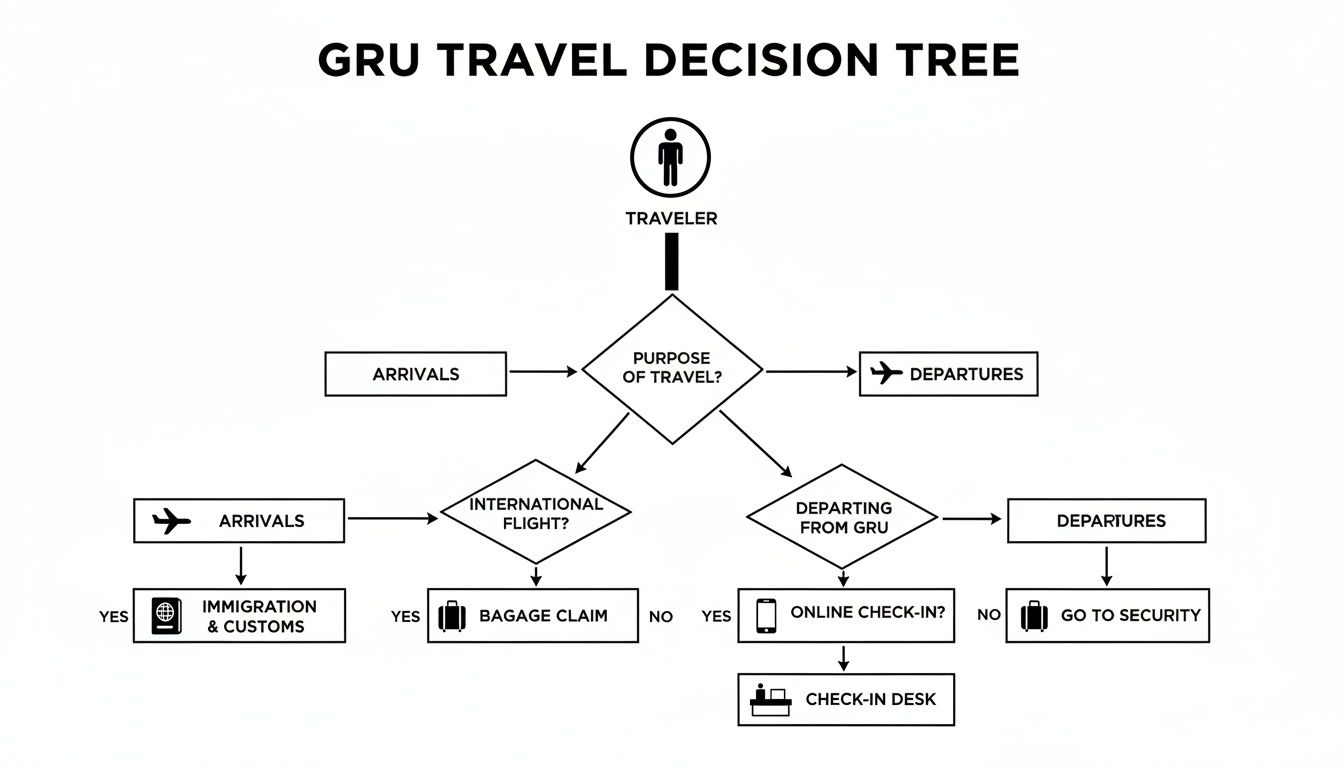
This flowchart acts as a simple cheat sheet, showing you the different paths for arriving and departing passengers and what to expect at each checkpoint.
International to International Connections
Good news—this is the easiest transfer of them all. If both of your GRU airport flights are international and you're simply in transit, the process is a breeze.
As long as your luggage is checked all the way through to your final destination, you typically won't have to touch it. You also get to skip Brazilian immigration entirely. Just follow the signs for international connections ("Conexões Internacionais"), pass through a dedicated security check, and head straight to your next gate.
Your Guide to Seamless Airport Transportation
You’ve navigated the terminals, made your connections, and finally landed. But the journey isn't quite over. That last leg—getting from the airport to your final stop—can often be the most stressful part, especially after a long-haul flight. This is where a little planning for your ground transportation can be a total game-changer, swapping potential chaos for a smooth and calm ride.
With the explosion in GRU airport flights, the airport has become a massive global hub, sometimes seeing over 4 million passengers in a single month. For us travelers, that's great for flight options but not so great for crowds and congestion. A pre-arranged transfer service is the perfect antidote, giving you a dose of reliability right when you need it most. You can actually see the data on GRU's incredible passenger growth on ceicdata.com.

Why Pre-Booked Transfers Are a Smart Choice
Picture this: you walk out of the arrivals hall, tired and a bit disoriented, and there’s a driver holding a sign with your name on it. No haggling with taxi drivers. No fumbling with a rideshare app on spotty airport Wi-Fi. No wondering if you’re being taken for a ride—literally. That’s the beauty of pre-booking your transfer.
It's all about taking the guesswork out of the equation. Your ride is paid for, your driver is waiting, and a clean, safe car is ready to go. They’ll usually help you with your bags and already know the quickest way to your hotel, leaving you free to just sit back, relax, and start your trip on the right foot.
A pre-arranged transfer isn't just a ride; it's peace of mind built right into your itinerary. It’s what makes the jump from air to ground travel feel effortless.
If you’re looking for a dependable option, it's worth checking out a reliable airport shuttle service that knows the ins and outs of GRU.
The Ideal Solution for Departures and Business Travel
The perks aren't just for arrivals. Booking a transfer for your departure flight is one of the smartest things you can do to ensure you get to the airport on time, every time. A professional service will suggest the perfect pickup time based on your flight schedule and São Paulo's notorious traffic, so you’ll have plenty of breathing room to check in and get through security.
This kind of reliability is an absolute must for corporate travelers. When you're on a business trip, every minute counts. A dedicated transfer service just makes sense:
- Timeliness: Your pickup is scheduled, so you’re never late for a flight or a critical meeting.
- Professionalism: A clean car and a courteous driver always make a good impression.
- Efficiency: Drivers who know the city well save you precious time.
- Simplicity: With fixed pricing and easy booking, expense reports are a breeze.
Whether you’re with family and need the assurance of a safe ride or you’re a professional who can't afford a single delay, a pre-arranged transfer from GRU is a solid, high-quality solution. It turns what could be a frantic final step into one of the easiest parts of your journey.
Answering Your Top Questions About Flights at GRU
Even the most seasoned travelers have questions when navigating a massive airport like GRU. Let's run through some of the most common things people ask, so you can feel confident and prepared for your trip.
Think of this as your quick-reference guide for those last-minute "what if" moments.
How Early Do I Really Need to Get to GRU?
At an airport this busy, timing is critical. For international flights, the golden rule is to be at the airport at least three hours before takeoff. This isn't just a suggestion; it gives you a realistic cushion for check-in lines, security screening, and the all-important passport control without breaking a sweat.
If you're flying domestically within Brazil, arriving two hours early usually does the trick. That said, if you're traveling during a major holiday (like Carnival or Christmas) or a big event, it's wise to tack on an extra 30 to 60 minutes. The airport gets incredibly crowded during those times.
What's the Best Way to Track My Flight?
You'll want real-time updates, and the most reliable sources are the official GRU Airport website and your airline's own mobile app. These will give you the most accurate info on delays, gate changes, and boarding times for any flight coming in or going out.
Pro Tip: The easiest way to stay in the loop is to sign up for your airline's flight alerts. They'll ping you with a text or email the second anything changes, so you're not constantly having to check an app.
This little step saves a lot of stress and helps you quickly adjust if your plans need to change on the fly.
I Have a Long Layover. Can I Sleep at the Airport?
Yes, you can. GRU Airport never closes—it's open 24/7. While you could try to catch some sleep in the general terminal seating, you’ll be much more comfortable with one of these options.
Here are your best bets for an overnight or extended layover:
- In-Airport Hotel: The TRYP by Wyndham is located right inside the international transit area of Terminal 3, making it incredibly convenient.
- Nearby Hotels: You'll find a ton of hotels just a short distance from the airport, and almost all of them provide free shuttle service back and forth.
- VIP Lounges: Several lounges offer a quiet escape with comfy chairs, food, and other amenities. You can often buy a day pass, or you might already have access through your airline status or a premium credit card.
Help! What Happens if I Miss My Connection?
First, don't panic. The key is to act fast. Go directly to your airline’s transfer desk or customer service counter—you'll find them within the terminal.
If you missed the connection because your first flight was delayed (and both flights are on the same reservation), the airline is typically on the hook to get you on the next available flight, free of charge. If you missed it for your own reasons, you may have to buy a new ticket. Either way, talking to the airline immediately is the only way to sort it out.
To make sure your ground transportation is just as smooth as your flight, let Gru Airport Transfers take care of your ride. You can book your reliable, stress-free car today at https://gruairporttransfer.com and travel with total peace of mind.

